
It’s the first Saturday of December. The card reader at register two freezes, a customer asks if the blue jacket is in stock at another branch, three online pickup orders are waiting in the back and your manager wants today’s sales against target before closing. You handle all of it, and you still call it “just working in a store.”
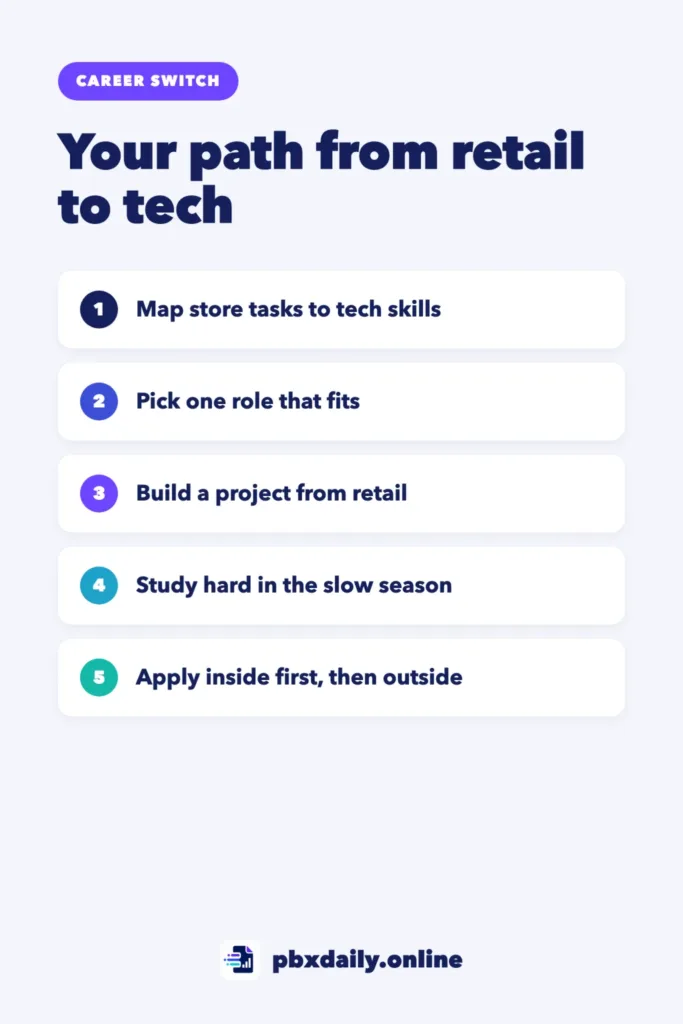
The move from retail to tech gets shorter when you pick a role that uses the part of the store you like most: the numbers, the systems, the website or the selling. This guide shows which retail tasks count in tech, five roles that use them, a project for each and a plan that follows the retail calendar.
What Retail Already Taught You
Most hiring managers have never closed a store at night. Translate your work for them:
| What you do in retail | Where it counts in tech |
|---|---|
| Chasing sales targets and reading the daily sales report | Data analysis and reporting |
| Using the point-of-sale (POS) and stock system all day | IT support and QA testing |
| Counting stock and tracking shrink (lost, damaged or stolen items) | Data cleaning |
| Handling online orders and in-store pickup | E-commerce operations |
| Knowing the product and helping people buy it | Tech sales |
| Following opening and closing checklists | QA and process work |
5 Tech Roles That Fit Retail Experience
Data Analysis for Sales and Inventory
A typical day: You clean sales and stock data, compare weeks and months and build reports that show what sold, what didn’t and where stock is running low.
What you need: Strong spreadsheets, basic SQL and one dashboard tool. Your edge is context: you know why sales jump before a holiday and why a stock count can be wrong.
Your proof: One analysis of public retail sales data with a short recommendation. Our guide on how to become a data analyst with no experience covers the skills in order.



E-commerce Operations
A typical day: You keep an online store running. You update products in the catalog, check prices and photos, set up promotions and fix orders that went wrong.
What you need: Care with details and spreadsheets for bulk product updates. Online sales are a real part of retail: in the United States, the Census Bureau estimated that e-commerce made up 17.1% of total retail sales in the second quarter of 2026.
Your proof: Pick one product category on a public online store and write an audit of unclear titles, missing sizes, broken filters and weak photos, with a fix for each.
IT Support for Store Systems
If you’re the person who gets the register, the label printer or the scanner working again, IT support is a natural fit. We cover this role in detail in our guide on moving from customer service to tech, and our overview of entry-level tech jobs for career changers compares it with others.
QA for Online Stores and Checkout
A typical day: You test an online store before customers see a change. You write test cases for the cart, coupons, payment and delivery options, report bugs and confirm the fixes.
What you need: Attention to detail and precise writing. You already know what real customers try at checkout, so you’ll think of cases a developer might miss.
Your proof: A test plan and five bug reports for the checkout of a public online store. Our guide to QA testing with no experience explains the basics.
Tech Sales (SDR)
A typical day: A sales development representative (SDR) at a software company researches possible customers, sends emails, makes calls and books meetings for a senior salesperson, often called an account executive.
What you need: Curiosity, resilience after a “no” and comfort with targets. An honest warning: of these five roles, this one depends most on strong spoken English. Calls with buyers abroad are live and fast. If you aren’t comfortable speaking English on the phone yet, start with another role while you practice, and check each listing for language and time zone requirements.
Your proof: A one-page account plan for a real software company: who its customers are, three businesses that could use it and a first email to one of them.
How to Choose: Sales Floor, Stockroom or Back Office?
- Which part of your shift do you enjoy most? The closing report points to data. Online orders point to e-commerce operations. Fixing the register points to IT support. Spotting wrong price tags points to QA. Helping a customer choose points to tech sales.
- Would you take calls in English every day? If not, choose data, e-commerce operations or QA, which happen mostly in writing.
- Do targets motivate you or drain you? SDR teams usually track numbers every week. Data and QA have deadlines but fewer personal targets.
- What does your company already have? An online store, an IT help desk or a reporting team at head office is the shortest route in.
Pick the role that comes up most often in your answers.
From Retail to Tech: A Plan Built Around the Retail Calendar
Retail has a yearly rhythm. In many countries the biggest peak is the end-of-year holidays, but yours may also include back-to-school or local festivals. Plan around it:
- Peak season: keep it small. Ten to 20 minutes a day of review is enough. Don’t start a big project. Do note which systems failed: those notes become interview examples.
- Slow months: build. Finish your one project on your days off, using the proof listed for your role.
- After the peak: apply. Your project is ready, your schedule is calmer and your peak-season results are fresh for your resume.
- Look inside first. Ask your manager who runs the online store, IT or reports at head office, and offer to help with one task.
Turn Your Store Experience Into a First Project
- Data: The U.S. Census Bureau’s retail trade programs call their surveys “the most comprehensive data available on retail economic activity in the United States.” In the Time Series / Trend Charts tool, select “Monthly Retail Trade and Food Services,” or download the Excel time series from the Quarterly E-Commerce Report. Ask which months peak for one type of store and how online sales changed over time. Your country’s statistics office may publish similar figures.
- QA: On a public online store, test adding to the cart, changing quantities, removing items, entering a wrong coupon and switching delivery options. Stop before payment. Never enter a real card, never place an order you don’t want and never try to break the site’s security.
- E-commerce operations: Write the category audit, with before and after versions of five product titles.
One rule for every project: never use data from your own store. No customer names, receipts, card details, loyalty data or staff schedules, even with names removed, and no screenshots of internal systems.
Rewrite Your Retail Experience for Tech Jobs
| Before | After |
|---|---|
| Did stock counts. | Ran weekly counts of about 1,200 items and traced mismatches between the stock system and the shelf. |
| Handled online orders. | Prepared online pickup orders and reported recurring order errors to the e-commerce team. |
| Met sales targets. | Tracked daily sales against target and changed displays based on what the numbers showed. |
Write only what’s true and use your own figures. Our career change resume guide for tech shows the full format.
Mistakes to Avoid
- Calling it “just sales.” You used targets, stock systems and online orders every day. Name the tools.
- Hiding your numbers. Sales against target and items counted make a retail resume read like business experience.
- Quitting before you have an offer. Your job pays the bills and gives you examples.
- Aiming at all five roles. Each needs different proof. Pick one.
- Ignoring your company’s e-commerce team. They already know your work.
Retail to Tech: Frequently Asked Questions
Do I need to learn to code to leave retail for tech?
Not for every role. E-commerce operations, IT support and tech sales need little or no coding to start. Data analysis needs spreadsheets and SQL, a query language rather than full programming. QA usually starts with manual testing; automation, which uses code, can come later.
What is the easiest tech job to get from retail?
The closest one is the role that matches what you already do. If you handle online orders, e-commerce operations is a short step. If you fix store systems, IT support is. If you love selling and speak English with confidence, tech sales may be.
Can I move into tech inside my retail company?
Often, if it has an online store, an IT team or a reporting team. Ask your manager for one small task with that team and share your project. Internal moves depend on the company, so apply outside too once your project is ready.
Sources
- U.S. Census Bureau: Monthly Retail Trade
- U.S. Census Bureau: Quarterly E-Commerce Report
- U.S. Census Bureau: Time Series / Trend Charts
Your Next Step
This week, write down three tasks you did at work that match a row in the first table. Choose the role that uses most of them and put its project on your calendar for the next slow month. Then follow our roadmap on how to switch to tech with no experience. When interviews start, learn how to present your portfolio in an interview.

Luiz Loiola is a digital strategist and the founder of PBX Daily. He writes about technology, programming, artificial intelligence, freelancing, remote work, career change, and online income, helping beginners and professionals build practical digital skills, create new career opportunities, and compete in the global online market.