
Ask a teacher what they could offer a tech company and you’ll often hear, “I only know how to teach.” Yet every week they set learning goals, break hard topics into small steps, check what students learned and adjust the next lesson. Companies call that instructional design.
The move from teacher to tech doesn’t start from zero. Planning lessons, explaining difficult ideas and giving useful feedback are already tech skills. Your task is to pick the role that uses them most and prove it with one project. Here are five roles that fit, what each asks for and a plan built around the school calendar.
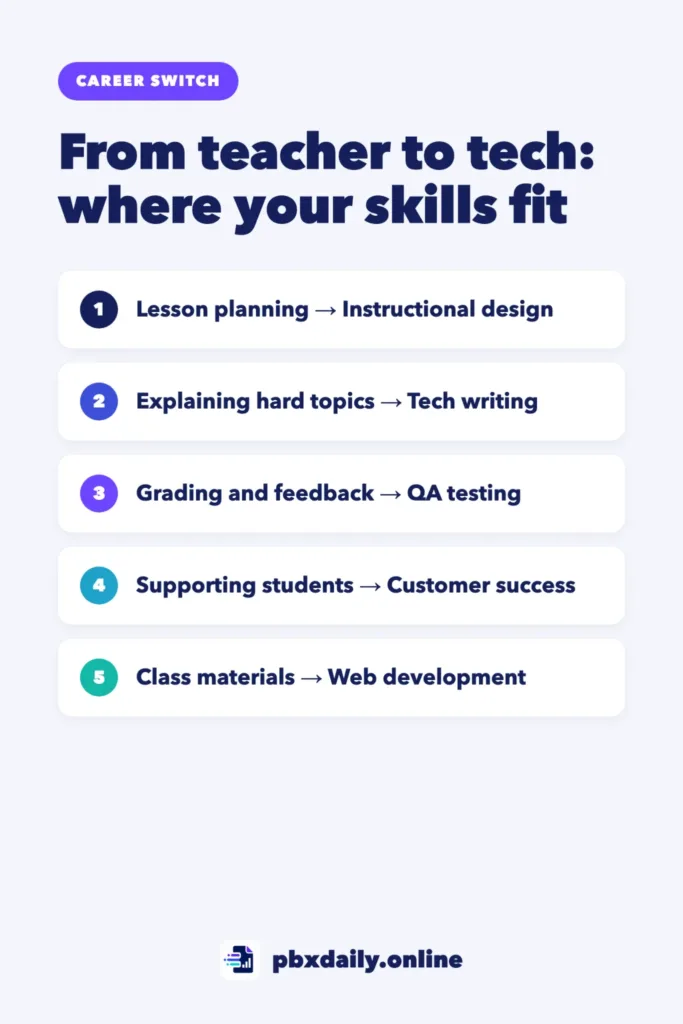
What Teachers Already Bring to Tech
Recruiters rarely translate classroom experience for you, so do it yourself:
| What you do in the classroom | Where it counts in tech |
|---|---|
| Planning lessons and units | Project planning and instructional design |
| Grading work and giving feedback | QA testing and content review |
| Explaining complex topics in simple steps | Documentation and technical writing |
| Managing a class and talking with parents | Working with clients, users and teams |
| Creating slides, worksheets and quizzes | Training materials and simple web pages |
| Helping a student who is stuck | Customer support and onboarding |
5 Tech Jobs for Former Teachers
Instructional Design and Corporate Training
What the day looks like: You design learning for adults: onboarding programs, online modules and workshops. You work with subject experts, decide what people need to learn and check whether the training worked.
What it asks for: In the United States, the BLS projects employment of training and development specialists to grow 11% from 2025 to 2035. The typical entry-level education is a bachelor’s degree, and some positions ask for related experience, such as teaching. The US median annual wage was $69,280 in May 2025.
Don’t confuse it with the school role of instructional coordinator, which, according to the BLS, typically requires a master’s degree and 5 years or more of related work experience, usually as a teacher or instructional leader.



How to prove it: Turn one of your lessons into a short self-paced module for adults, with a clear objective, one activity and a quiz.
Technical Writing
What the day looks like: You write how-to guides, help articles and product documentation. Much of the job is questioning engineers, testing the steps yourself and rewriting until a beginner can follow.
What it asks for: Clear writing and the patience to explain one thing in several ways, which teaching trains every day. In the United States, the BLS projects employment of technical writers to grow 1% from 2025 to 2035, slower than average, with a median annual wage of $90,390 in May 2025.
How to prove it: Rewrite a confusing help page for a free tool, showing before and after. A clear project README also works; see how to write a GitHub README for portfolio projects.
QA / Software Testing
What the day looks like: You test features before users see them, write test cases, report bugs and confirm fixes. Grading against a rubric is good practice: you compare work with clear criteria and write feedback someone can act on.
What it asks for: Attention to detail and clear, neutral writing. In the United States, the BLS projects employment of software quality assurance analysts and testers to grow 6% from 2025 to 2035. Our guide to entry-level tech jobs for career changers covers it in more detail.
How to prove it: Write a test plan and five bug reports for an education app you used with your students.
Customer Success and Support at EdTech Companies
What the day looks like: You help schools and teachers start using a learning platform, answer questions, run training sessions and pass feedback to the product team.
What it asks for: Product knowledge, patience and clear communication. You’ve been the user, so you know what confuses teachers on a busy Monday morning. Roles built around live calls often need confident spoken English, so check each listing.
How to prove it: Write a one-page onboarding guide for a platform you used in class, plus a sample reply to a frustrated teacher.
Web Development
What the day looks like: You build and fix the parts of websites and apps that people use.
What it asks for: This role needs the most new technical learning. Your edge is that you know how people learn. Start with HTML, CSS and JavaScript in the right order, and see our comparison of entry-level tech roles for what the work involves.
How to prove it: Build a small tool you would have used as a teacher, like a vocabulary quiz or random group generator, and publish it with public code.
How to Choose Between Them
- Which part of teaching do you enjoy most? Planning points to instructional design, explaining in writing to technical writing, checking work to QA and helping people one-on-one to customer success.
- Do you still want to teach, just in a different setting? If yes, corporate training keeps the part you love.
- How much technical learning can you take on this year? Less: customer success or instructional design. More: QA or web development.
- Do you prefer working in writing or talking with people all day? Writing fits technical writing and QA. Talking fits training and customer success.
If two answers point to the same role, start there.
From Teacher to Tech: A Switch Plan That Fits the School Calendar
Teachers have an advantage most career changers don’t: a predictable calendar. Whether your school year ends in June or December, the plan works the same way.
- During the term, learn in small blocks. Study your chosen role a few hours a week, on the days with less grading.
- During the break, build your project. Use your longest break for the one project that proves your target role. A week of focused time does more than a month of tired evenings.
- Toward the end of the school year, apply. Update your resume and LinkedIn, then apply in the final months, so a new job can start at a natural break. Check your contract’s notice period before you resign.
For the full process, follow our roadmap on how to switch to tech with no experience.
How to Describe Teaching Experience for Tech Jobs
Swap school language for skills and results a company recognizes:
| Before | After |
|---|---|
| Taught English to teenagers. | Designed and delivered a full-year English course, including lesson plans and assessments. |
| Graded tests and homework. | Reviewed work against clear criteria and wrote specific feedback students could act on. |
| Created materials for my classes. | Built reusable digital materials (slides, quizzes and guides) shared with colleagues. |
Use only what’s true, and add real numbers, such as class sizes. Our guide to the career change resume for tech covers it in depth, with examples by background.
Mistakes Teachers Make When Switching
- Hiding the teaching years. Leaving them off your resume throws away your best evidence.
- Collecting certificates instead of building. A course shows you studied. A project shows how you work.
- Chasing all five roles at once. Each needs different proof. Choose one, or two at most.
- Keeping education jargon. Terms like “formative assessment” mean little to most recruiters. Translate them.
- Forgetting the calendar trade-off. Most tech jobs don’t follow a school year, so the long breaks disappear.
Teacher to Tech: Frequently Asked Questions
Do I need a new degree to move from teacher to tech?
Usually not to get started. For training and development specialists, the BLS lists a bachelor’s degree as the typical entry-level education, which most teachers already have. The school role of instructional coordinator is the exception, with a master’s degree as the typical requirement. For the other roles, a project that proves the skill matters more than a new diploma.
How long does the switch from teacher to tech take?
There’s no fixed timeline, because it depends on the role and the hours you can study. The plan above fits into one school year: learn during the term, build your project during the break and apply toward the end of the year.
Which tech job is the easiest first step for a teacher?
The one that uses the most of what you already do. For many teachers that’s instructional design or customer success at an edtech company, because both build on planning, explaining and supporting learners. QA and web development need more new technical skills.
What other tech jobs suit former teachers?
Teachers also move into UX research, sales enablement and product roles. Those listings often ask for more specific experience, so many people explore them after a first role in one of the five areas above.
Sources
- U.S. Bureau of Labor Statistics: Training and Development Specialists, Occupational Outlook Handbook
- U.S. Bureau of Labor Statistics: Instructional Coordinators, Occupational Outlook Handbook
- U.S. Bureau of Labor Statistics: Technical Writers, Occupational Outlook Handbook
- U.S. Bureau of Labor Statistics: Software Developers, Quality Assurance Analysts, and Testers, Occupational Outlook Handbook
Your Next Step
This week, list three things you did in class last month that match a row in the first table. Then choose the role that uses the most of them and write down the one project you’ll build during your next break.

Luiz Loiola is a digital strategist and the founder of PBX Daily. He writes about technology, programming, artificial intelligence, freelancing, remote work, career change, and online income, helping beginners and professionals build practical digital skills, create new career opportunities, and compete in the global online market.