
If you handle 40 tickets a day, you might describe your job as “I just answer the phone.” Look closer. You find out what went wrong, calm someone who is upset, follow a process, write notes the next person can use and close the case before the next one arrives. Tech companies pay people to do exactly that.
The move from customer service to tech is shorter than most people think. Support work already trains what entry-level tech roles ask for first: solving someone’s problem under pressure, documenting it and explaining the fix clearly. Below you’ll find five roles that use those skills, how to prove each one and a plan that fits around your shifts.
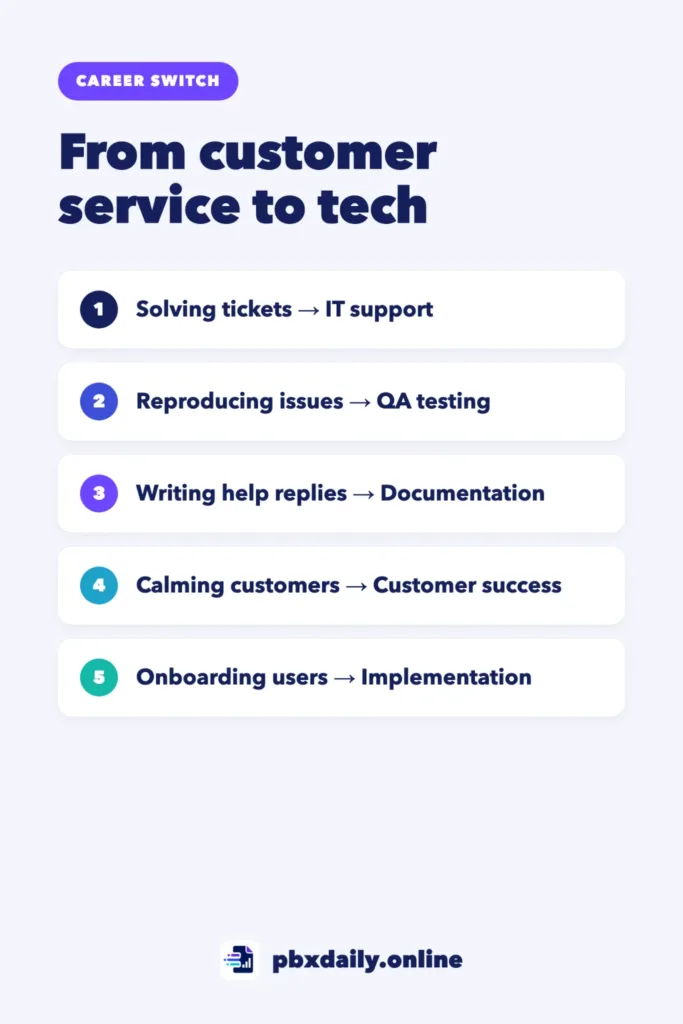
What Customer Service Already Taught You
Hiring managers won’t always connect your experience to their job, so make the connection for them:
| What you do in customer service | Where it counts in tech |
|---|---|
| Logging, updating and closing tickets | IT support and help desk workflows |
| Asking questions until you understand the real problem | Troubleshooting |
| Reproducing a customer’s issue step by step | QA testing and bug reports |
| Writing help replies and knowledge base articles | Documentation |
| Calming upset customers and keeping them | Customer success |
| Walking new customers through setup | Implementation and onboarding |
| Meeting response-time targets | Service level agreements (SLAs) in IT teams |
5 Tech Roles for Customer Service Workers
IT Support / Help Desk
What the day looks like: You answer tickets from employees or customers about laptops, accounts, passwords, networks and software. You fix what you can and escalate the rest with clear notes.
What it asks for: Patience, a calm voice and basic knowledge of computers and networks. In the United States, the BLS reports a median annual wage of $62,890 for computer support specialists in May 2025. Employment is projected to decline 3% from 2025 to 2035, but the BLS still expects about 48,700 openings each year on average. User support specialists typically need some college courses, though candidates may qualify with a high school diploma plus relevant IT certifications.
How to prove it: Write five short troubleshooting guides for common problems, such as a slow laptop or a failed password reset. Add an entry-level IT certification if the jobs near you ask for one.



Technical Support for Software Products
What the day looks like: You support customers of one software product. You reproduce their issues and check settings and error messages. Then you write clear tickets so engineers can fix bugs fast.
What it asks for: Deep product knowledge and basic web skills, like reading an error in the browser. Much of this work happens by email and chat, which helps if you write English better than you speak it. Our guide to learning HTML, CSS and JavaScript in the right order covers the web basics.
How to prove it: Pick a free tool you know well. Document three common problems with the exact steps to fix each one, written for a customer and for an engineer.
QA / Software Testing
What the day looks like: You test features before users see them, write test cases, report bugs and confirm fixes. If you’ve ever said “can you tell me exactly what you clicked?”, you already think like a tester.
What it asks for: Attention to detail and neutral, precise writing. In the United States, the BLS projects employment of software quality assurance analysts and testers to grow 6% from 2025 to 2035. Their median annual wage was $104,300 in May 2025. That median covers all experience levels, so don’t expect it in your first role.
How to prove it: Write a test plan and five bug reports for an app you use every day. Our guide to entry-level tech jobs for career changers explains the role in more detail.
Customer Success
What the day looks like: You look after a group of customer accounts after the sale. You check how they use the product, run check-in calls, help them reach their goals and spot accounts that might cancel.
What it asks for: Relationship skills, product knowledge and some comfort with spreadsheets and CRM tools. This role uses more live calls than technical support, so confident spoken English matters. Check each listing.
How to prove it: Write a 30-day success plan for an imaginary customer of a real product, with goals, check-in dates and warning signs to watch.
Implementation / Onboarding Specialist
What the day looks like: You set up new customers on a product. You configure accounts, import their data, train their team and hand them over to support once everything works.
What it asks for: Organization, patience with technical setup and the ability to train people who are busy and a little stressed. Spreadsheets and file imports come up often.
How to prove it: Build an onboarding checklist and a short training guide for a free tool, then record a five-minute walkthrough.
How to Choose the Right First Role
- Which part of your job do you like most? Fixing problems points to IT support or technical support. Finding what’s broken points to QA. Building relationships points to customer success. Setting people up points to implementation.
- Do you want to keep talking with customers? If yes, customer success and implementation keep that part. If you’d rather work mostly in writing, look at QA or technical support.
- How much technical learning can you take on this year? Less: customer success or implementation. More: IT support, technical support or QA.
- What does your company already have? If it has an IT team or a software product, an internal move may be your fastest path.
If two answers point to the same role, start there.
From Customer Service to Tech: A Plan That Fits Around Your Shifts
Shift work makes long study sessions hard, so the plan uses short blocks and your days off.
- Study in short blocks. Thirty to 45 minutes before or after a shift is enough if you do it most days. Keep one topic per block.
- Use your current job. Volunteer for harder tickets, help update the knowledge base or test new features before launch. Each one gives you a real example for interviews.
- Build one project on your days off. Choose the proof listed for your target role above and finish it before starting anything else. Our list of portfolio project ideas by target role has more options.
- Apply inside first, then outside. Ask your manager about openings in IT, QA or onboarding. Then apply to outside roles that match your project.
For the full process, follow our roadmap on how to switch to tech with no experience, and compare roles in our overview of entry-level tech jobs.
Rewrite Your Customer Service Experience for Tech Jobs
Swap call center language for skills and results a tech company recognizes:
| Before | After |
|---|---|
| Answered customer calls and emails. | Resolved about 40 customer issues per day by phone, email and chat while meeting response-time targets. |
| Helped customers with problems. | Diagnosed account and billing issues, reproduced errors and escalated bugs with clear steps for the technical team. |
| Wrote answers for common questions. | Wrote and updated 15 knowledge base articles that agents used to handle repeat questions. |
Use only what’s true and replace the numbers above with your own. For full examples by background, see our career change resume guide for tech.
Mistakes to Avoid
- Calling your experience “not technical.” If you used a ticketing system, a CRM or a knowledge base, you used business software every day. Say so.
- Collecting courses instead of proof. A certificate shows you studied. A project shows how you work.
- Applying to every role at once. Each role needs different proof. Pick one, or two at most.
- Quitting before you have an offer. Your current job pays the bills and gives you examples. Keep it while you build.
- Ignoring internal moves. Your company already trusts you. That’s a real advantage over outside candidates.
Customer Service to Tech: Frequently Asked Questions
Do I need a degree to move from customer service to tech?
Not always. For computer support specialists, the BLS says user support specialists typically need some college courses, and candidates may qualify with a high school diploma plus relevant IT certifications. Requirements vary by company and country, so read the listings in your area. For most of these roles, a project that proves the skill carries a lot of weight.
What tech job is easiest to get from customer service?
The one closest to what you already do. For many people that’s technical support at a software company or IT help desk work, because both build directly on handling tickets and solving problems. Customer success and implementation are also close. QA asks for a little more new learning, mainly writing test cases and bug reports.
Can I stay in customer service while I learn?
Yes, and it’s usually the smart choice. Keeping your job gives you income and fresh examples for your resume and interviews. Study in short blocks around your shifts, use days off for your project and look for tasks at work that match your target role, like testing new features or writing help articles.
What should I put on my resume?
Lead with results, not duties. Show volume, speed and quality: how many issues you solved, which tools you used and what you improved, such as help articles you wrote. Add your project near the top. Our career change resume guide has before and after examples by background.
Sources
- U.S. Bureau of Labor Statistics: Computer Support Specialists, Occupational Outlook Handbook
- U.S. Bureau of Labor Statistics: Software Developers, Quality Assurance Analysts, and Testers, Occupational Outlook Handbook
Your Next Step
On your next shift, notice three tasks you do that match a row in the first table. Then choose the role that uses the most of them and write down the one project you’ll finish on your next days off.

Luiz Loiola is a digital strategist and the founder of PBX Daily. He writes about technology, programming, artificial intelligence, freelancing, remote work, career change, and online income, helping beginners and professionals build practical digital skills, create new career opportunities, and compete in the global online market.