
The recruiter’s email arrives on a Tuesday morning: the company wants to hire you. The offer is 3,000 USD a month as a contractor, starting in two weeks. Is that fair? Can you ask for more without losing the job? And what about fees, days off and the hours you’d need to be online?
This guide shows how to negotiate a remote job offer from a foreign company: how to set your floor in USD, when to talk numbers, what to ask for beyond the rate, how to make one counteroffer and how to confirm every change in writing, with four email scripts you can copy. All amounts are illustrative examples, not market rates.
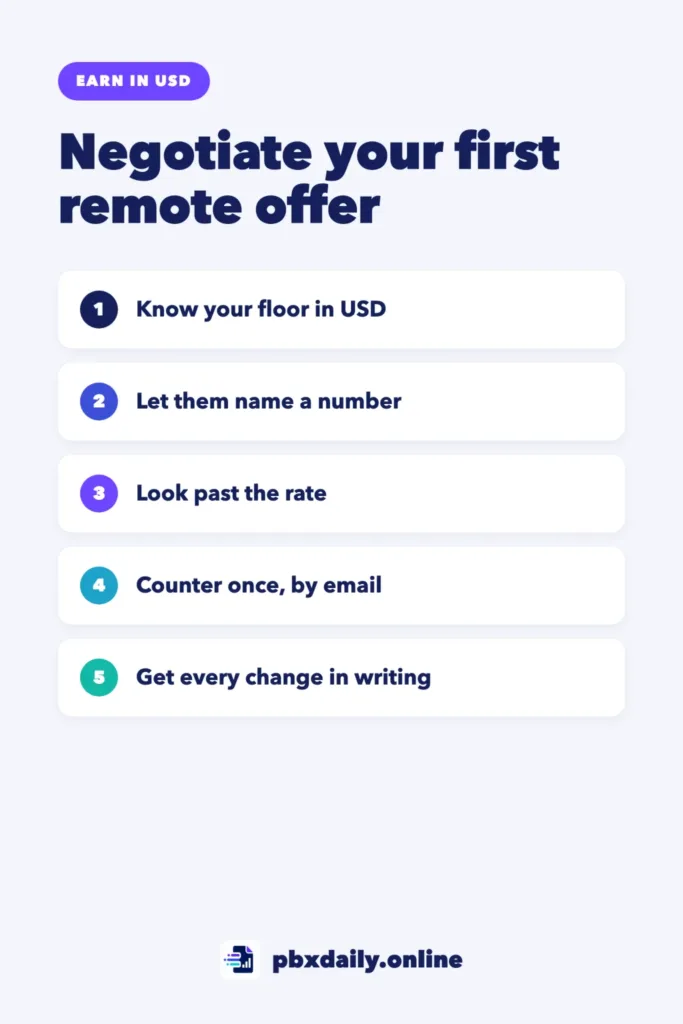
Before You Negotiate: Know What Kind of Offer It Is
First, check how you’ll be hired, because the setup changes what’s open to discussion:
- Contractor: the rate, fees, notice, paid days off and equipment all depend on your contract, so you can discuss each one.
- Employee through an employer of record (EOR): salary and start date are usually open; many benefits follow local law.
- Hiring platform: the rate is negotiable, but the platform’s fees and payment dates usually aren’t.
Our guide to contractor vs employee with a foreign company explains each setup. This article covers only the negotiation.
Step 1: Work Out Your Floor and Your Target
Your floor is the lowest offer you’d accept. Your target is the number you’ll ask for. Start with the yearly value method from that guide: what you’d actually keep after taxes, accountant, transfer fees, equipment and unpaid time off. Then work backward.
An illustrative example: you need to bill at least 36,000 USD a year to cover taxes, costs and living expenses, and you plan to take one month off unpaid, so you’ll bill for 11 months:



- Monthly floor: 36,000 ÷ 11 = about 3,273 USD.
- Hourly floor: 36,000 ÷ (11 × 160 hours) = about 20.45 USD an hour.
So the 3,000 USD offer from the opening is below your floor: a clear reason to negotiate.
Don’t just convert your local salary into dollars: your costs as a contractor are different. Set your target from the range you find in Step 2. Pricing a single project instead? Use our guide on how to price your first freelance web project.
Step 2: Research the Range for the Role
Base your target on real numbers, not guesses. Look in three places:
- Job posts: some remote posts list a pay range. Collect a few for the same role and level.
- The company: check its careers page. Some companies explain how they set pay by location.
- The recruiter: ask, “Is there a set range for this role, and does it depend on where I live?”
A range meant for one country isn’t automatically yours. If you find nothing reliable, build your target from your floor and the role’s demands.
Step 3: Let Them Name a Number First, If You Can
When a recruiter asks, “What are your rate expectations?”, try to hear their budget first:
“I’d like to understand the full scope first. Could you share the range you’ve budgeted for this role?”
If they insist, give a range in USD that starts at or above your floor, such as “3,300 to 3,700 USD a month” in the example. The company may offer the bottom of it, so pick a bottom number you’d gladly accept. Our guide on how to prepare for a remote interview with a foreign company covers the short version.
Step 4: Look Past the Rate
If the rate can’t move much, other terms still change what you keep. Pick the two or three that matter most:
| What to ask for | How to ask |
|---|---|
| Payment in USD | “Could the rate be paid in USD?” |
| Transfer fees | “Would the company cover transfer fees?” |
| Payment frequency | “Could I be paid twice a month?” |
| Paid days off and holidays | “Could the contract include paid days off and my local public holidays?” |
| Notice period | “Could we agree on the same notice for both sides?” |
| Equipment and internet | “Is there an allowance for equipment or internet?” |
| Overlap hours | “Can we fix the overlap window, such as four hours a day?” |
| Rate review | “Could we review the rate after six months?” |
| Trial period | “Can we put the trial length and what happens after it in writing?” |
Who pays the fees matters. Our comparison of Wise vs Payoneer vs PayPal explains them, and our guide on how to invoice international clients shows why the currency should be agreed before work starts.
Step 5: Make One Counteroffer, With Reasons
If the offer is below your target, send one counteroffer by email. You get time to choose your words, and the recruiter gets something to forward to whoever approves the budget.
- One number, not a range.
- Two reasons tied to the role, such as a skill they need or the range you found.
- No ultimatum and no invented competing offers.
If the rate is fixed, ask for one item from the table instead. Negotiating doesn’t guarantee a better number.
How to Negotiate a Remote Job Offer in USD: 4 Email Scripts
Change the details in brackets. The numbers in script 2 follow the illustrative example above.
1. Ask for Time to Decide
Subject: Thank you for the offer

Hi [name],

Thank you for the offer for the [role] position. I'm excited
about the work.

Could I take until [day, date] to review it? It would also help
to have the full terms in writing, including rate, currency and
start date.

Best regards,
[Your name]
2. Make a Counteroffer
Subject: Re: Offer for [role]

Hi [name],

Thanks again for the offer. I'd love to join [company].

Based on the [skill / overlap hours] this role needs and the
ranges I've seen for similar remote positions, I'm asking for
3,500 USD a month instead of 3,000 USD.

If the rate is fixed, I'd be glad to discuss [transfer fees /
a rate review after six months] instead.

Best regards,
[Your name]
3. Accept and Confirm the Terms in Writing
Subject: Accepting the offer for [role]

Hi [name],

I'm happy to accept. To confirm what we agreed:

- Rate: [amount] USD per [month/hour]
- Payment: [frequency], via [method], fees paid by [who]
- Start date and hours: [date], [overlap window]
- Paid days off and holidays: [terms]
- Notice: [weeks] for both sides
- Rate review: [date]

Could you confirm these will be in the contract?

[Your name]
4. Decline Politely
Subject: Offer for [role]

Hi [name],

Thank you for the offer and for your team's time. After
thinking it over, I've decided not to accept, because
[the rate is below my minimum].

I'd be glad to stay in touch for future roles.

Best regards,
[Your name]
Step 6: Get Every Change in Writing
A deal isn’t done until it’s on paper. Send script 3 the same day, then read the contract line by line. Every term you agreed on should be there. If something is missing, ask before you sign. Writing the agreement yourself? Our checklist of what to include in a freelance contract shows where each term goes.
What Not to Do
- Accepting on the call. Say thanks and ask for the offer in writing.
- Negotiating against yourself. Don’t lower your number before they reply.
- Asking again after “final.” Once you accept a final offer, don’t reopen the rate.
- Paying to start. Real employers don’t charge for equipment or training. Our guide on how to spot remote job scams lists the signs.
Negotiating a Remote Job Offer: Frequently Asked Questions
Is it OK to negotiate my first remote job offer?
Yes. Asking about pay and terms is a normal part of hiring, even for a first role. Be polite, give reasons and ask once. If the offer already meets your target, accept and confirm the terms in writing.
Can a company withdraw an offer if I negotiate?
It’s possible: a company can change its mind before anything is signed. One polite counteroffer with real reasons keeps the risk lower than ultimatums or repeated requests. If you can’t afford to lose the role, ask about fees or a rate review instead of the rate.
Should I ask for my rate in USD or in my local currency?
If the company pays in USD or asks for numbers in dollars, ask in USD, so your floor and the offer use the same unit. A rate in your local currency moves the exchange risk to the company and may slow approval. Either way, write the currency into the contract.
Note: This article is general information, not legal or tax advice. Employment and tax rules vary by country and change over time. Talk to a qualified professional where you live before making decisions. Read our full Disclaimer.
Your Next Step
Write two numbers in a note today: your floor and your target. Save the four scripts so they’re ready when an offer arrives. Still interviewing? Learn how to present your portfolio in an interview first.

Luiz Loiola is a digital strategist and the founder of PBX Daily. He writes about technology, programming, artificial intelligence, freelancing, remote work, career change, and online income, helping beginners and professionals build practical digital skills, create new career opportunities, and compete in the global online market.