
Carlos had everything ready for his first interview with a company in Germany: notes about the product, a clean shirt and a quiet room. He joined the call at 10:00 sharp and found an empty meeting. The clocks in Germany had changed that weekend, his hadn’t, and the interview had started an hour earlier.
A remote interview with a foreign company is often decided before the call even begins. This guide shows you how to prepare for a remote interview with a foreign company step by step: confirm the time zone and format, test your setup, learn the usual hiring stages and get ready for the questions only international candidates hear.
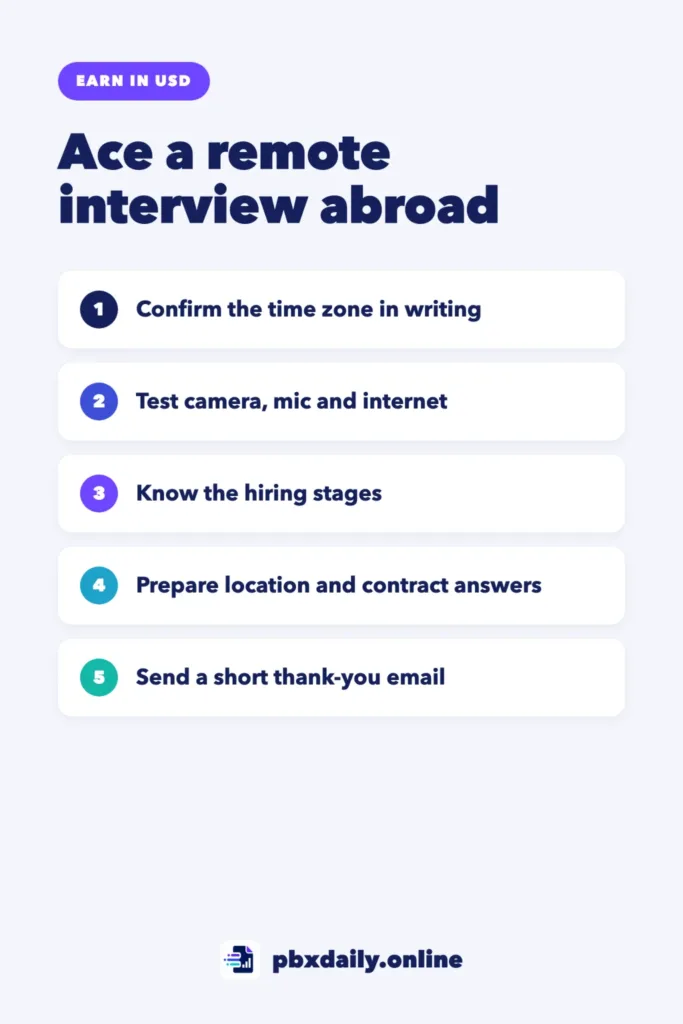
Confirm the Basics: Time Zone, Format and Who You’ll Meet
As soon as you get the invite, reply in writing and repeat the time in both time zones. This one sentence prevents most scheduling mistakes:
“Thanks for the invite. Just to confirm: Tuesday at 3:00 p.m. CET, which is 11:00 a.m. for me in São Paulo.”
Be extra careful around daylight saving time. Countries change their clocks on different dates, and many don’t change them at all. If your interview falls in a week when one side changes, check the time again the day before.
Then confirm the rest:



| What to confirm | How to ask |
|---|---|
| Platform | “Will we use Zoom, Google Meet or Microsoft Teams?” |
| Format | “Will this be a conversation, or should I be ready to write code or share my screen?” |
| Length | “How long should I plan for?” |
| Interviewers | “Could you tell me who I’ll be speaking with and their roles?” |
Once you have names, look at their public profiles and read the job description again. You’ll know whether to expect technical questions, questions about your past work or both.
Set Up Your Space and Tech
Test everything a day early, on the same device and platform you’ll use.
- Connection: use a cable if you can, or sit close to your router. Close downloads and ask people at home to avoid streaming during the call.
- Camera: place it at eye level, with light in front of you and a plain background behind you.
- Audio: headphones with a microphone reduce echo. Record a short test call and listen to it.
- Screen: close extra tabs and turn off notifications before you share your screen.
Then prepare a plan B. Install the meeting app on your phone, keep mobile data ready as a hotspot and save the recruiter’s email address. If your connection drops, send a short message right away: “My connection dropped. I’m rejoining from my phone now.” What interviewers remember is how calmly you handle it.
Know the Usual Hiring Stages
Every company runs its own process, but most include some version of these stages. The order can change, and smaller companies often combine them.
| Stage | What it usually checks | How to prepare |
|---|---|---|
| Screening | Your background, location, availability and expectations | Prepare a two-minute summary of who you are and why this role fits. |
| Technical | Your skills, through live coding, a take-home task or a project discussion | Review the skills in the job description and practice explaining your own projects out loud. |
| Behavioral | How you work with others and handle problems | Prepare short stories with the STAR method below. |
| Final | Fit with the team and the manager | Prepare your questions about contract, pay and hours. |
You don’t need to guess. At the end of each stage, ask: “What are the next steps in the process?” Most recruiters will tell you what comes next and when you can expect to hear back.
Questions Foreign Companies Ask International Candidates
Some questions come up only because you live in another country. Prepare clear, honest answers before the screening call.
“Where are you based?”
Give your city, country and time zone in one sentence. If the role has location rules, the recruiter needs to know quickly whether they can hire you there. Only mention relocation if you’re really open to it.
“How much overlap can you have with our hours?”
Answer with a specific window in their time zone, not yours: “I can be available from 9:00 a.m. to 1:00 p.m. your time every weekday.” A clear number shows that you’ve already thought about how the team works together.
“Are you open to working as a contractor?”
Companies hiring abroad often use one of three setups: hiring you as an independent contractor, employing you through their own local company or using an employer of record, a third-party company that employs you on their behalf. Each one means different paperwork, taxes and benefits, and the rules depend on your country. You don’t need to decide during the interview. Ask which setup they use, then check the details with a local accountant before you sign. Our guide to remote jobs for non-native English speakers explains these options in more detail, and our comparison of Wise vs Payoneer vs PayPal covers how to receive payments in another currency.
“How comfortable are you working in English?”
The interview itself is your answer, so be honest and specific: “I work in English every day in writing. On calls, I sometimes ask people to repeat, and I always confirm decisions in writing.” For phrases you can use in technical interviews, see our guide to English for software developers. For calls with non-technical people, read how to communicate with international clients in English.
How to Answer Behavioral Questions (STAR, Briefly)
Behavioral questions start with phrases like “Tell me about a time when…” The STAR method gives your answer a simple shape:
- Situation: where you were and what was happening.
- Task: what you were responsible for.
- Action: what you did. Say “I”, not “we”.
- Result: what happened and what you learned.
Here’s a short example for “Tell me about a time you missed a deadline”:
“In my last project, I was building a booking page for a client. Two days before the deadline, I found a bug in the payment step. I told the client the same day, explained the problem and proposed a new date two days later. I fixed the bug, added a test for it and delivered on the new date. Now I test the payment flow first, not last.”
Prepare four or five stories like this before the interview. If you’re changing careers, stories from your previous job count. Handling an angry customer or a broken process shows the same skills a tech team needs.
Questions to Ask in a Remote Interview With a Foreign Company
Your questions show that you understand how international work happens in practice. Ask about money and contracts with the recruiter, usually in the first or last stage, not with the technical interviewer.
- Contract: “Would I be hired as a contractor, an employee or through an employer of record?”
- Currency and payment: “In which currency is the role paid, and how are payments sent?”
- Payment schedule: “How often are payments made?”
- Equipment: “Do you provide a laptop or an equipment budget?”
- Hours: “Are there core hours when everyone needs to be online?”
- Holidays: “Do I follow the holidays in my country or in yours?”
Pick the two or three that matter most to you.
Your 48-Hour and 15-Minute Checklist
48 Hours Before
- Confirm the date and time in both time zones, in writing.
- Test the platform, camera, microphone and connection on your interview device.
- Read the job description and the company website again.
- Write your answers about location, overlap and contract in a notes file.
- Prepare your STAR stories and two or three questions to ask.
- Choose a project you can explain in five minutes.
15 Minutes Before
- Restart your computer and close every app you don’t need.
- Turn off notifications and silence your phone.
- Open the meeting link, your notes and your project.
- Check your camera, light and audio one last time.
- Keep water nearby and join two or three minutes early.
After the Interview
Send a short thank-you email within one working day. Keep it to a few lines and mention one specific thing from the conversation, so it doesn’t read like a template.
Subject: Thank you for today's interview

Hi [Name],

Thank you for taking the time to talk with me today about
the [Role] position. I enjoyed learning about [specific topic
from the call], and it made me even more interested in
joining the team.

If you need anything else from me, such as code samples or
references, I'm happy to send it.

Best regards,
[Your name]
[Link to your portfolio]
If the recruiter gave you a date and it passes without news, a polite one-line follow-up is fine: “Hi [Name], I wanted to check if there are any updates on the [Role] position.”
Remote Interviews Abroad: Frequently Asked Questions
What if my English isn’t perfect?
Most international teams don’t expect perfect English. They expect you to be clear. Speak a little more slowly, use simple sentences and ask the interviewer to repeat a question if you missed part of it. “Sorry, could you say that again?” is a normal request on any call and won’t count against you.
Should I mention salary in USD?
If the company pays in US dollars or asks for your expectation in dollars, yes. Otherwise, ask first which currency the role is paid in, then answer in that currency. Research typical pay for the role before the call, and give a range you’ve thought about instead of a number you make up on the spot.
How do I handle a time zone mistake?
Contact the recruiter as soon as you notice, by email or the channel they used. Apologize once, explain briefly and offer two or three new times in their time zone. Don’t write a long excuse. A fast, calm and professional reply often matters more than the mistake itself.
Your Next Step
Open your notes app now and write your answers to three questions: where you’re based, which hours you can overlap and whether you’re open to working as a contractor. Then save the thank-you email template. If you’re still looking for interviews, start with our guide to finding remote jobs as a non-native English speaker.

Luiz Loiola is a digital strategist and the founder of PBX Daily. He writes about technology, programming, artificial intelligence, freelancing, remote work, career change, and online income, helping beginners and professionals build practical digital skills, create new career opportunities, and compete in the global online market.