
A client messages you: “Deal, let’s do it!” Two weeks later you’re on the sixth round of changes. The client has added a blog and a booking page, and nobody has mentioned paying for any of it. Nothing was written down, so neither of you can point to what you actually agreed.
Knowing what to include in a freelance contract prevents most of that. You don’t need a long legal document for a small project. You need a few clear clauses in plain language that both sides read before the work starts. This guide covers ten of them in order, explains why each one matters and gives you an outline to adapt.
Do You Really Need a Contract for a Small Project?
Yes, but it can be short. A contract is a written record of what you both agreed: what you’ll deliver, when, for how much and what happens if plans change. For a small website, one or two pages is often enough.
It protects the client too, because they know exactly what they’re paying for. Most disagreements in small projects don’t come from bad intentions. They come from two people remembering the same conversation differently.
If you’ve already sent a proposal, its scope, timeline and price become the core of the contract. Our guide on how to write a freelance proposal that gets replies shows how to build that base.
What to Include in a Freelance Contract: 10 Clauses in Order
Use these as a checklist. The order follows the way a project happens: who, what, when, how much and what to do when something changes.



1. Parties
Write the full name of each side, the business name if there is one, contact details and the city and country where each is based. If the client is a company, use the company’s name, not only your contact’s.
2. Scope and Deliverables
This is the most important clause. List every page, feature and file you’ll deliver, then add a “not included” line, such as writing the text, buying a domain or ongoing maintenance. “A modern website” isn’t a scope. “A five-page site with a contact form, delivered live along with the source files” is.
If details are missing, go back to these questions to ask a client before building a website.
3. Timeline and Client Responsibilities
Give dates for the first draft and final delivery. Then write what you need from the client and by when: text, photos, logins and feedback. Tie your dates to theirs, for example “final delivery [number] business days after I receive all content.” If their files arrive late, the deadline moves with them.
4. Revisions
State how many rounds of revisions are included and what a “round” means. A clear definition is one combined list of changes, sent at once. Then say how extra rounds are handled, for example billed at your hourly rate.
5. Payment Terms, Deposit and Late Payment
Write the total price, currency and payment method. Split it into steps, such as a deposit before you start and the rest on delivery, and give each step a due date. Add what happens if a payment is late, for example that work pauses until it’s paid.
To set the number itself, use the method in how to price your first freelance web project. If the client is in another country, also decide who pays transfer and conversion fees. Our guide to getting paid by foreign clients can help you choose a method.
6. Ownership and Usage Rights
Say who owns the final work and from when. Many freelancers write that the client receives the rights to the finished site once the full payment is made. List anything you don’t hand over, such as code you reuse across projects or fonts, photos and plugins with their own licenses. If you want to show the project in your portfolio, ask for that permission here.
7. Confidentiality
If the client shares private information, such as customer data, passwords or business plans, add a short clause saying you’ll keep it private and use it only for the project. Agree on how logins are shared and when you stop using them.
8. Changes to the Scope
New ideas halfway through a project are normal. The contract should say how they’re handled: the client asks in writing, you reply with the extra price and the new dates, and work on the change starts only after they approve.
9. Ending the Contract
Explain how either side can end the agreement early: with written notice, how many days of notice and what gets paid for work already done. Say what the client receives if the project stops halfway, such as the files completed so far.
10. Signatures
Both sides sign and date the final version, for example on a PDF, and you keep a copy of exactly what you both accepted. What counts as a valid signature depends on where you and the client are, so check locally if the project is large.
A Simple Contract Outline You Can Adapt
Replace everything in brackets. This is a structure to organize your own document, not a ready-to-sign contract, and it doesn’t cover the rules where you or your client live.
FREELANCE SERVICES AGREEMENT
Date: [date]

1. Parties
Freelancer: [your name], [business name, if any], [email], [city, country]
Client: [client or company name], [contact person], [email], [city, country]

2. Scope and deliverables
The freelancer will deliver:
- [Page or feature 1]
- [Page or feature 2]
- [Files or access to hand over]
Not included: [for example, writing the text, hosting costs]

3. Timeline and client responsibilities
First draft: [date]
Final delivery: [number] business days after the client provides [content]
The client will send feedback within [number] business days.

4. Revisions
Includes [number] rounds of revisions.
One round = one combined list of changes.
Extra rounds: [rate or price per round]

5. Payment
Total: [price] [currency], paid by [payment method]
- [Deposit] before work starts
- [Remaining amount] on delivery, due within [number] days
Late payment: [for example, work pauses until payment arrives]
Transfer fees paid by: [freelancer / client / shared]

6. Ownership and usage rights
After full payment, the client owns [what].
The freelancer keeps [reused code, tools, licensed assets].
Portfolio use: [allowed / allowed after launch / not allowed]

7. Confidentiality
[What stays private and how logins are handled]

8. Changes to the scope
New requests are quoted in writing and start only after approval.

9. Ending the agreement
Either side can end it with [number] days of written notice.
The client pays for [work completed so far] and receives [files].

10. Signatures
Freelancer: [name], [date]
Client: [name], [date]
Keep your wording that simple. For clients abroad, see our guide on how to communicate with international clients in English.
Some governments publish model agreements. New York State’s Department of Labor, for example, offers a model freelance worker agreement on its website. It was written for one US state, so use it to see how a complete contract is organized, not as a document for where you live.
Freelancer vs Independent Contractor
In everyday use, “freelancer” usually describes how you work: on your own, for several clients, project by project. “Independent contractor” is a term many contracts and official documents use for someone hired to do a job who isn’t an employee.
The exact meaning, and what it changes for taxes, benefits and your rights, depends on the country and sometimes the state or region. If the label matters for your situation, ask a local accountant or lawyer.
Mistakes That Make Contracts Useless
- A vague scope. If the deliverables aren’t listed, the contract can’t settle a disagreement about them.
- No number of revisions. Without a number, the client can reasonably expect changes until they’re happy.
- Signing after the work starts. Once half the project is delivered, you have much less room to ask for a deposit or change the terms.
- Copying a template you don’t understand. If you can’t explain a clause to your client in one sentence, rewrite it or remove it.
- Agreeing to changes only on a call. Follow every change with a short written summary, even a message, so the agreement stays up to date.
Freelance Contracts: Frequently Asked Questions
What should a freelance contract include?
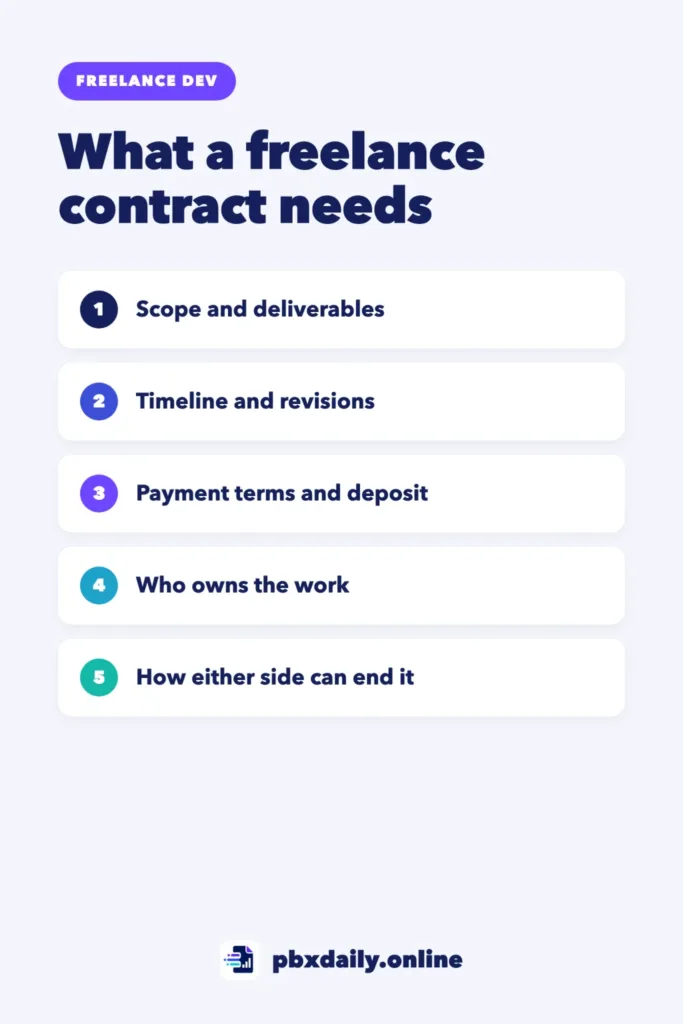
At a minimum: who the parties are, the scope and deliverables, the timeline, the number of revisions, the price and payment terms, who owns the work, how scope changes are handled and how either side can end the agreement. Add confidentiality if the client shares private information. For a small project, all of that can fit on one or two pages.
How do I write a freelance contract?
Start from your approved proposal, since it already has the scope, timeline and price. Then add what it doesn’t cover, such as revisions, ownership, changes and ending the contract. Use the outline above as a structure, write in plain language and ask the client to read it before you both sign. For larger projects, have a local professional review it.
Is an email agreement enough?
An email where both sides confirm the scope, timeline, price and payment terms is far better than nothing. Many small projects start that way. Whether it works as a contract depends on the laws where you and the client are, which this guide can’t answer. For bigger projects, a signed document with all ten clauses is the safer choice.
Note: This article is general information, not legal advice. Laws about contracts, freelance work and payments vary by country. For larger projects, or if anything in a contract worries you, talk to a local lawyer or another qualified professional.
Sources
- New York State Department of Labor: Freelance Isn’t Free Act
- New York State Department of Labor: Freelance Worker Agreement (model contract, PDF)
Your Next Step
Copy the outline into a document today and fill it in for your current or next client, using the scope and price from your proposal. Then read each clause and ask: would the client understand this without my help? If not, rewrite it before you send it.

Luiz Loiola is a digital strategist and the founder of PBX Daily. He writes about technology, programming, artificial intelligence, freelancing, remote work, career change, and online income, helping beginners and professionals build practical digital skills, create new career opportunities, and compete in the global online market.