
Your first international client pays a 500 USD invoice. Then the money reaches your bank and the number is noticeably smaller. The client sent the full amount, your bank shows no fee and nobody can say where the difference went.
Most Wise vs Payoneer vs PayPal comparisons give you a fee table and a winner. But the real cost depends on your country, how your client pays and how the money reaches your local bank. This guide shows the four costs to compare, how each service charges them and a five-minute test to find your own cost.
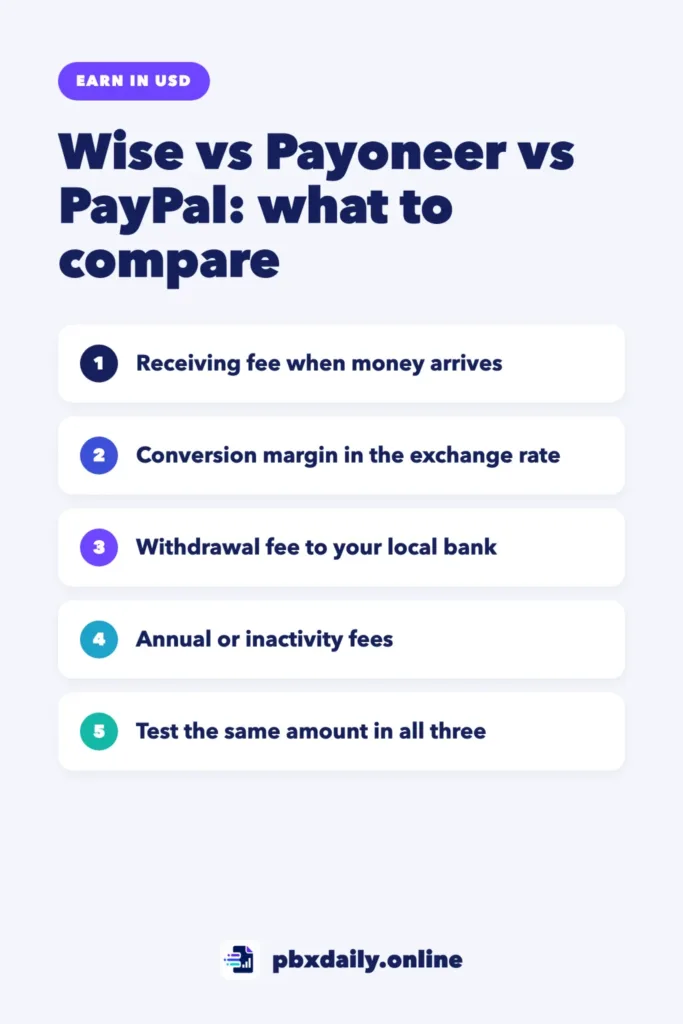
The 4 Costs You Need to Compare
The missing money usually comes from four places:
- Receiving fee. What you pay when the money arrives. It often depends on whether the client pays by local transfer, international wire or card.
- Currency conversion. A visible fee plus any margin hidden in the exchange rate. The benchmark is the mid-market rate, the midpoint between buy and sell prices shown in most currency converters.
- Withdrawal to your local bank. A fixed amount or a percentage to move the money to your bank account.
- Annual or inactivity fees. Charges on the account itself, for example when you receive little or stop using it.
How Each Service Works for Freelancers
The pages below were checked on October 10, 2026. Fees depend on the country where your account is registered, so confirm the page for your own country.
Wise
How the client pays: Wise gives you local account details in several currencies, including USD, EUR and GBP, so your client sends a normal bank transfer.
What’s usually free: Wise’s receive pricing page for US residents and its UK and Philippines versions (no update date shown) list free account details and free domestic, non-wire USD payments. Its pricing page says there are no subscriptions or plans.



Where the cost is: USD wire and Swift payments cost a fixed 6.11 USD each on those pages, and converting has a fee that varies by currency. Wise says it uses the mid-market rate and shows the fee upfront. Pages differ by country: India’s says receiving is currently for business customers only and lists a conversion fee, an eFIRC fee and 18% GST on Wise’s fees.
Payoneer
How the client pays: your client sends a bank transfer to your Payoneer receiving account, pays from their Payoneer balance or pays by card or bank debit.
What’s usually free: the Payoneer pricing page (“Last updated on 1 January 2026”) lists payments from other Payoneer users and into a receiving account in your local currency as free.
Where the cost is: if USD isn’t your local currency, each payment into a USD receiving account costs 1% (minimum 1.00 USD). Cards, bank debits, conversions and withdrawals also have fees, and an annual fee applies if you receive little. Payoneer says fees vary by location, payment method, currency and corridor, and your account shows the ones that apply to you.
PayPal
How the client pays: from their PayPal account or by card, often through a PayPal invoice. The money lands in your PayPal balance.
What’s usually free: PayPal’s US business fee page (“Last Updated: October 1, 2026”) lists no fee for a standard withdrawal to a linked bank account without currency conversion.
Where the cost is: that page applies only to accounts of US residents. Most payment types carry a percentage plus a fixed fee, international payments add another percentage and conversions include a spread in the exchange rate. Each market or group of markets has its own page: Germany’s, updated September 7, 2026, lists an inactivity fee that the US page doesn’t. Find yours through the “Fees” link at the bottom of PayPal’s site.
Wise vs Payoneer vs PayPal Side by Side: What Each Charges For
All pages were checked on October 10, 2026. Wise’s US, UK and Philippines pages show no update date, Payoneer’s page was updated January 1, 2026 and PayPal’s US page was updated October 1, 2026. Use this table to know what to look for, not as your final cost.
| Cost | Wise | Payoneer | PayPal (US accounts) |
|---|---|---|---|
| Receiving | Domestic USD free; 6.11 USD per USD wire or Swift payment | Free in your local currency; 1% (minimum 1.00 USD) in other currencies; card up to 3.99% + 0.49 USD; bank debit 1% | 3.49% + 0.49 USD (PayPal Checkout in USD) or 2.99% (goods and services); plus 1.50% if international |
| Conversion | Varies by currency, from 0.23% (US page); mid-market rate | 0.50% between balances | Spread of 3.00% (4.00% for some types) or as shown in the transaction |
| Withdrawal | Sending fee varies by currency, from 0.23% (US page) | 1.2% to 4% on most routes; minimum up to 20 USD in some countries | Standard: free without conversion; instant: 1.50% |
| Annual or inactivity | No subscriptions or plans | 29.95 USD if you receive under 6,000 USD in any 12 consecutive months | None on the US page; up to 10 EUR on Germany’s page |
Which One Fits Your Situation
Start with how your client pays, not with the brand. If you’re not sure, ask. Our guide on communicating with international clients in English can help you phrase it.
Your Client Pays by Bank Transfer
Ask whether it will be a domestic transfer or an international wire. Wise and Payoneer both give you local account details in foreign currencies, so the client can often pay with a local transfer. That matters: Payoneer’s receiving accounts page says intermediary banks on wires may charge their own fees, typically averaging 20 to 30 USD. Compare the receiving fee for your route, then add conversion and withdrawal.
Your Client Wants to Pay by Card
On Payoneer’s page and PayPal’s US page, cards cost more than bank payments. Wise’s receive pricing page covers bank payments, not cards. Agree in advance who covers the fee, or include it in your rate.
Your Client Already Uses PayPal
It’s often the easiest option for the client. On your side, add the commercial fee, the international fee and the conversion spread from your country’s page. Payoneer also lists payments from a payer using PayPal (US only), at up to 3.99% + 0.49 USD.
You’re Paid Through a Freelance Platform
The platform decides which withdrawal methods you can use and may charge its own fee. Payoneer, for example, says fees for marketplace payments vary by marketplace. Check the platform’s payment help pages, then test the methods it offers.
How to Test the Real Cost in Your Country
Give each service five minutes:
- Pick one realistic amount, such as your next invoice, and the way your client will pay it.
- Open the fee page or calculator for your country, plus your account’s fees section if you have one.
- Note the receiving fee for that payment method.
- Compare the exchange rate to the mid-market rate at the same moment. If the mid-market rate is 5.00 and you’re offered 4.85, you lose 3% in the rate alone.
- Add the withdrawal fee and a share of any annual fee.
What matters is the final amount in your local bank. Repeat the test when your client, your country or the fees change.
Keep Records for Taxes
Whichever service you use, save these for every payment:
- The invoice you sent
- The payment confirmation or statement
- The exchange rate and fees on each conversion
- The transfer to your local bank
Tax rules for foreign income vary by country, so ask a local accountant how to report it. A guide on invoicing international clients is coming soon.
Once payments work, focus on finding clients and charging enough. Our guides to remote jobs for non-native English speakers and how to price your first freelance web project can help. This is general information, not financial advice, and fees change often, so confirm them on the official page for your country.
Wise vs Payoneer vs PayPal: Frequently Asked Questions
Is Wise better than Payoneer?
Neither is better for everyone. Both give you local account details in foreign currencies. Wise’s pages list free domestic USD payments and a conversion fee that varies by currency. Payoneer charges 1% to receive in a currency that isn’t your local one and also handles card payments and marketplace payouts. Run the five-minute test with your own invoice to compare.
Is it better to use Wise or PayPal?
It depends on how your client pays. If they can send a bank transfer, compare Wise’s receiving and conversion fees with PayPal’s percentage, fixed fee and conversion spread for your country. If the client will only pay through PayPal or by card, PayPal may be the practical choice, and the fee becomes part of your rate.
How much does Payoneer charge for $1,000?
It depends on the payment method and your country. Using the rates on Payoneer’s pricing page (updated January 1, 2026): a 1,000 USD transfer into a USD receiving account costs 10 USD (1%) if USD isn’t your local currency. Paid by card, it costs up to 40.39 USD (3.99% + 0.49 USD). Withdrawal or conversion fees come on top.
What is better, Payoneer or PayPal?
On the pages checked for this guide, Payoneer’s fees for bank payments (free to 1%) are lower than PayPal’s US rates for commercial payments (2.99% or more, plus 1.50% if international). PayPal can still be the easier option when the client already pays everything through PayPal. Check both fee pages for your country before you decide.
Sources
- Wise: Fees for receiving and adding money (United States)
- Wise: Fees for receiving and adding money (United Kingdom)
- Wise: Fees for receiving and adding money (Philippines)
- Wise: Fees for receiving money (India)
- Wise: Wise Fees & Pricing
- Payoneer: Pricing
- Payoneer: Multi-Currency Business Account: Receive Payments Locally
- PayPal: PayPal Merchant Fees (United States)
- PayPal: Merchant and seller fees (Germany, in German)
Your Next Step
Run the five-minute test for all three services today, using your next invoice amount and the fee pages for your country. Save the results so you can compare again when fees change.

Luiz Loiola is a digital strategist and the founder of PBX Daily. He writes about technology, programming, artificial intelligence, freelancing, remote work, career change, and online income, helping beginners and professionals build practical digital skills, create new career opportunities, and compete in the global online market.