
You had a good call with a potential client. They said, “Sounds great, send me a proposal.” You spent two evenings on a three-page document about your skills, your tools and how you learned to code. You sent it, and you never heard back.
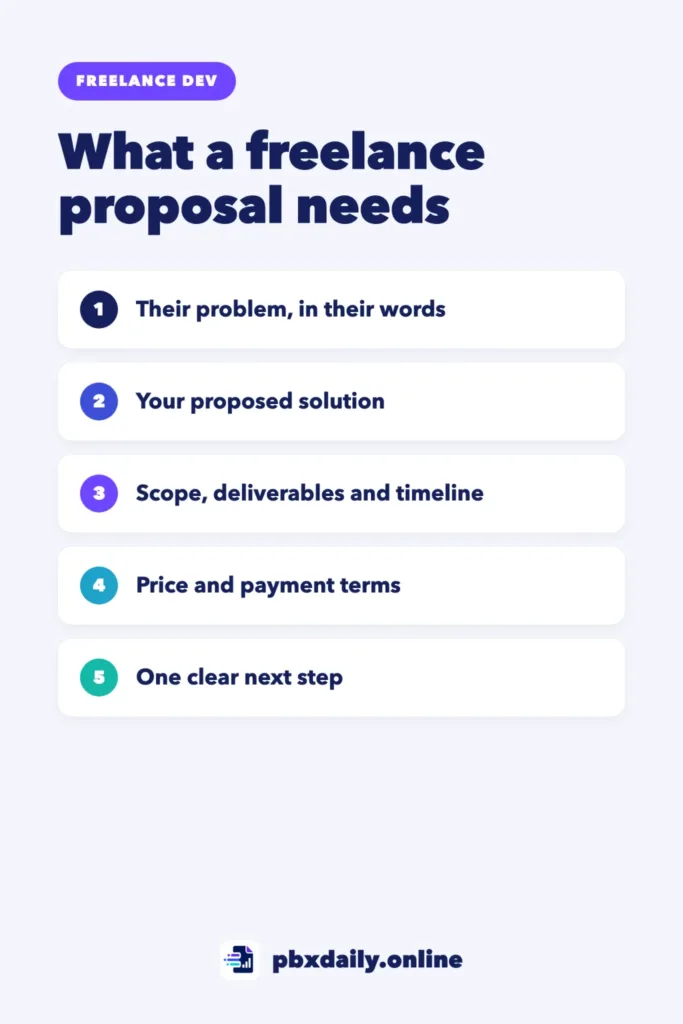
Learning how to write a freelance proposal that gets replies is less about length and more about focus. A proposal that gets answered is short, describes the client’s problem in the client’s own words and ends with one clear next step. This guide shows you the six parts in order, gives you a template to adapt and explains how to follow up without being pushy.
When to Send a Proposal (and When Not To)
A proposal works best as the answer to a conversation, not as a first contact. Send one when:
- You’ve had a call or a message exchange about the project.
- The client sent a brief or job post detailed enough to plan the work.
- The client asked you for a price or a plan.
Before that point, a short outreach message works better. Our guide on how to get your first freelance web development client covers that first contact. If the brief is too vague to estimate, ask two or three questions first. A proposal built on guesses usually guesses wrong. Our list of questions to ask a client before building a website covers what to ask.
How to Write a Freelance Proposal: The 6 Parts That Get Replies
Keep the parts in this order. Each one answers a question the client is already asking.
The Problem in the Client’s Words
Open with what the client told you, not with who you are. If they said “people can’t find our prices on their phones,” write that, not “suboptimal mobile user experience.” When clients read their own words, they know you listened.



Your Proposed Solution
Explain what you’ll build and how it solves that problem, in results the client cares about, such as “students can book a lesson from their phone.” Mention tools only if the client asked or if a choice affects them, such as who can edit the site later.
Then add one piece of proof: a link to a similar project you built, even a practice one. One relevant example does more than a list of everything you’ve ever made.
Scope and Deliverables
List exactly what’s included: pages, features and the number of revision rounds. Then add a short “not included” line, for example writing the text or ongoing maintenance. It protects you both when new requests appear halfway through.
Timeline
Give dates for the main milestones, such as a first draft and final delivery, and tie them to what you need from the client: “Final delivery 10 business days after I receive the text and photos.” That way, their late files don’t become your missed deadline.
Price and Payment Terms
State one price for the defined scope, or two or three clear options at most. Say how and when you get paid, for example a deposit before you start and the rest on delivery. Work out the number first, using the method in how to price your first freelance web project. If the client is abroad, see Wise vs Payoneer vs PayPal to choose how you’ll get paid.
One Clear Next Step
End with a single action that’s easy to take, such as “Reply ‘approved’ and I’ll send the deposit invoice.” Without one, busy clients tend to put the decision off.
A Simple Freelance Proposal Template
Copy this into an email or a short document and replace everything in brackets:
Subject: Proposal for [project name]

Hi [name],

Thanks for the call on [day]. Here's my proposal.

What you need
You mentioned that [problem in the client's words].

What I'll do
I'll build [solution], so that [outcome for their customers or team].

What's included
- [Page or feature 1]
- [Page or feature 2]
- [Number] rounds of revisions
Not included: [for example, writing the text]

Timeline
First draft by [date]. Final delivery [number] business days
after I receive [content you need].

Price and payment
[price] for the scope above. [Deposit] before I start,
the rest on delivery, paid by [payment method].

Next step
If this works for you, reply "approved" and I'll send the deposit
invoice so we can start on [start date].

[Your name]
For a small project, this fits on one screen. If yours runs longer, cut the parts about you first. Once approved, it becomes the base of your written agreement, which our guide on what to include in a freelance contract covers.
Short Version for Freelance Platforms
On a marketplace, your proposal sits next to many others, and the client often scans only the first lines. Here’s what changes:
| Part | Direct client | Freelance platform |
|---|---|---|
| Opening | The problem from your conversation | A specific detail from their job post |
| Length | About one screen | A few short paragraphs |
| Scope | Full list of deliverables | One question that shows you read the post |
| Price | Price with payment terms | Follows the platform’s current format and rules |
A good scope question might be “Will you provide the text, or should I use placeholder copy?” Send the full six-part proposal once the client replies.
How to Follow Up Without Being Pushy
Silence doesn’t always mean no. Clients get busy. Wait three to five business days, then send one short message:
Hi [name], just checking whether you had a chance to look at the
proposal for [project]. If the timing or scope needs to change,
I'm happy to adjust it. Would a 15-minute call this week help?
If there’s still no answer a week later, send a final note saying you’ll close the proposal for now, then move on. Don’t guilt the client, and don’t drop your price just to get a reply. For more phrases to reuse, see our guide on how to communicate with international clients.
Mistakes That Kill a Proposal
- Starting with your biography. The client wants proof that you understood the problem first.
- A vague scope. “A modern website” means something different to everyone.
- A price range so wide it means nothing. “Between [low] and [high]” leaves the client to do the deciding.
- No next step. If the client has to work out how to say yes, they may not bother.
- Sending it days later. Send it while the conversation is fresh, ideally within a day or two.
Freelance Proposals: Frequently Asked Questions
How long should a freelance proposal be?
For a small web project, about one screen. Long enough to cover the six parts, short enough to read in two minutes. Bigger projects can add detail to the scope, but the opening and the next step should stay short.
How do I write a freelance proposal with no experience?
Focus on the client’s problem and your plan, not on your history. For proof, build one sample project for that type of business first. Our guide to the beginner developer portfolio shows what makes a practice project convincing.
Should I send the proposal as a PDF or in the email itself?
For small projects, the email itself is usually easier: the client can read and reply without opening a file. A PDF makes sense for longer proposals or when the client needs to share it with someone else.
Your Next Step
Copy the template into a document today and fill it in for a real lead or a practice client, using the exact words from their message or brief. Then read it once more and cut every sentence that doesn’t help the client decide.

Luiz Loiola is a digital strategist and the founder of PBX Daily. He writes about technology, programming, artificial intelligence, freelancing, remote work, career change, and online income, helping beginners and professionals build practical digital skills, create new career opportunities, and compete in the global online market.