
A message arrives on WhatsApp from a “recruiter” you’ve never heard of. The job: rate products online, work from home, 40 USD an hour, no experience needed. A few days later, after some small payments that look real, you’re asked to deposit money to “release” your earnings. That’s when the job disappears, and so does your money.
Remote job scams target exactly the people looking for remote work paid in dollars, especially from outside the United States. The good news is that most of them follow a few patterns you can learn to spot. This guide covers the most common scams, the red flags at each stage of hiring, a five-minute check to confirm a company is real and what to do if you’ve already been targeted.
How Big the Problem Is
In a December 2024 report, the U.S. Federal Trade Commission said reported losses to job scams more than tripled from 2020 to 2023 and topped 220 million USD in the first half of 2024 alone. Reports of “task scams” jumped to about 20,000 in the first six months of 2024, compared with about 5,000 in all of 2023. The FTC notes that most fraud is never reported, so the real numbers are likely higher.
The Most Common Remote Job Scams
- Task scams. You’re paid to do simple tasks like rating products or liking videos in an app. Small payouts build trust. Then you’re told to deposit money, often in cryptocurrency, to continue or withdraw your “earnings.” The FTC describes these as “paying to get paid.”
- Fake check scams. The “employer” sends a check for equipment or training, asks you to deposit it and send part of the money to a vendor. The check bounces later, and you owe the bank the full amount, according to the FTC’s job scams guide.
- Pay-to-work scams. You’re asked to pay for training, certification, software or a “starter kit” before you can start. Honest employers don’t charge you to get a job.
- Fake recruiters from real companies. Someone uses the name of a well-known company, offers a job after a short chat and asks for your ID, bank details or a fee.
- Reshipping scams. The “job” is to receive packages at home and send them on. The goods are often bought with stolen cards, and you can end up involved in fraud.
Scams That Target Developers and Freelancers
If you work in tech or freelance, watch for a few extra tricks:
- Fake coding tests. A “company” asks you to download a project, install its dependencies and run it as part of a technical test. Unknown code can contain malware that steals passwords or crypto wallets. Review the code first, run it only in an isolated environment, or ask for a test you can complete in an online editor.
- Overpaying “clients.” A new client pays more than agreed and asks you to send the difference back or pay a “partner.” The original payment is later reversed.
- Fake platform messages. Emails that look like they come from a freelance platform ask you to log in through a link. Always open the platform yourself instead of clicking.
- Requests to move off a platform early. A client you met on a freelance site insists on paying outside it before any work starts. Besides breaking the platform’s rules, it removes your payment protection.
Red Flags at Every Stage
In the Job Listing or First Message
- An unexpected text or WhatsApp message offering work you never applied for.
- Vague tasks with buzzwords like “product boosting” or “app optimization.”
- Pay far above what similar roles offer, for little effort or no experience.
- No company name, or a company with no real website or history.
In the Interview
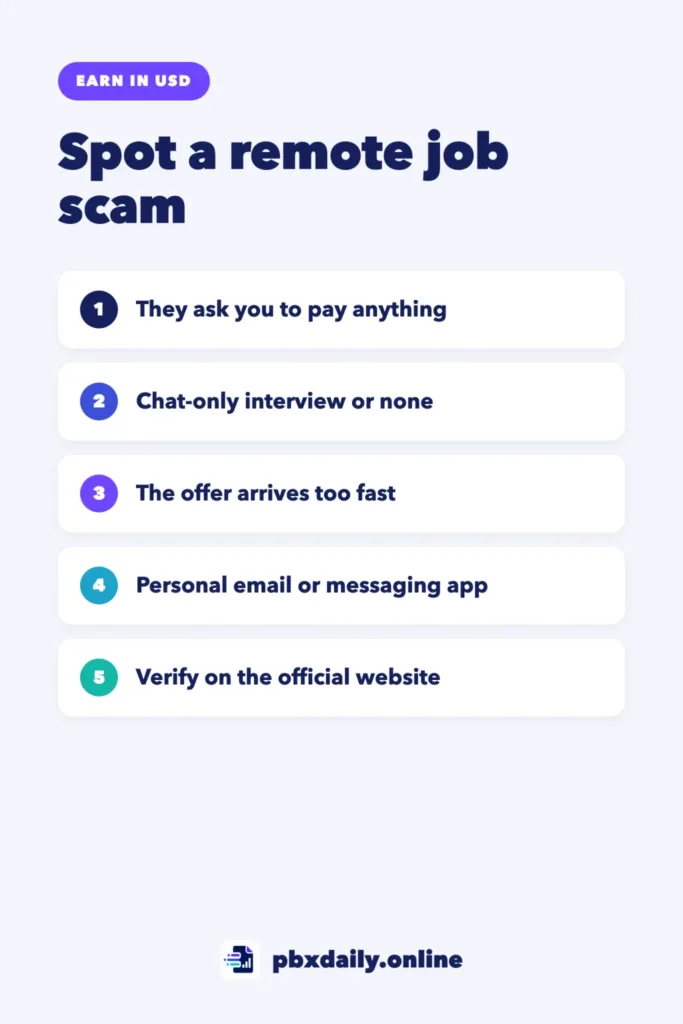
- The whole process happens by chat, with no video call.
- The “interview” is a few generic questions and you’re hired immediately.
- The recruiter uses a free email address instead of a company domain.
- You’re pressured to decide quickly or keep the offer secret.
In the Offer
- A request to pay for anything: equipment, training, software or a fee.
- A check to deposit before you start, with instructions to send money on.
- Requests for ID documents or bank details before you’ve seen a written contract.
- Payment promised only in cryptocurrency or gift cards.
Our guide to remote jobs for non-native English speakers lists more warning signs in job listings.
How to Check a Company Is Real in 5 Minutes
- Find the official website yourself. Search for the company name instead of using links from the message.
- Look for the job on their careers page. Real openings usually appear on the company’s own site or a known job board.
- Check the email domain. A recruiter from a real company should write from an address on the company’s domain, not a free email service or a lookalike domain with small spelling changes.
- Check the recruiter. Look for their profile on LinkedIn and confirm it’s connected to the company’s page and has a real history.
- Search for complaints. The FTC recommends searching the company or person’s name with words like “scam,” “review” or “complaint.”
If anything doesn’t match, contact the company through the official website and ask whether the job and the recruiter are real.



What a Real Remote Hiring Process Looks Like
Legitimate remote hiring usually includes an application or a referral, at least one video call with a real person, often a technical or skills step, and a written offer or contract before any personal financial details are requested. Payment details are collected for payroll or contractor payments after you’ve signed, not before you’ve spoken to anyone. Our guide on how to prepare for a remote interview with a foreign company describes the usual stages.
What to Do If You Were Targeted
- Stop responding and don’t pay anything else. Scammers often ask for “one last fee” to release your money.
- Contact your payment provider immediately. The FTC advises contacting the company you used to send money, reporting the fraud and asking to reverse the transaction if possible. This applies to banks, cards, payment apps and services like the ones in our Wise vs Payoneer vs PayPal comparison.
- Protect your identity. If you shared ID documents or bank details, contact your bank and follow your country’s process for identity theft.
- Report it. If the scam involved a U.S. company name or U.S. contacts, you can report it to the FTC at ReportFraud.ftc.gov. Also report it to the consumer protection or police authority in your own country, and to the job site or app where you were contacted.
Remote Job Scams: Frequently Asked Questions
How can you tell if a remote job is fake?
Most fake remote jobs ask for money, rush you, skip a real interview or contact you out of nowhere on messaging apps. If the job pays a lot for simple tasks, uses vague buzzwords or comes from someone without a company email address, treat it as a scam until you can verify it through the company’s official website.
Do real employers ask you to buy equipment?
Real employers may give you equipment or reimburse approved purchases, but they won’t send you a check to deposit and ask you to forward money to a vendor. According to the FTC, that pattern is a fake check scam.
Is it safe to give my bank details for payroll?
It’s normal to share payment details after you’ve signed a contract with a verified company, usually through their official payroll or contractor platform. It’s not safe to share them with someone you’ve only chatted with, before any contract, or through a messaging app.
Are remote jobs on big job sites always safe?
No. Large job sites remove many fake listings, but some get through, and scammers also copy real listings from known companies. Use the job site to find openings, then confirm the role on the company’s official careers page and check that every message comes from the company’s own domain before you share personal information.
Sources
- U.S. Federal Trade Commission: Job Scams
- U.S. Federal Trade Commission: Paying to get paid: gamified job scams drive record losses (December 2024)
Your Next Step
Save the five-minute check above and use it before you reply to any unexpected job offer. When you do land real international work, our guide on how to invoice international clients helps you get paid safely.

Luiz Loiola is a digital strategist and the founder of PBX Daily. He writes about technology, programming, artificial intelligence, freelancing, remote work, career change, and online income, helping beginners and professionals build practical digital skills, create new career opportunities, and compete in the global online market.