
The interviewer smiles and asks, “So, why tech?” You start with “Well, I know I don’t have a computer science degree, but…” and spend the next two minutes apologizing for your old career. The interviewer wanted to hear why you’re a good bet. You told them why you might not be.
Career change interview questions follow a pattern, and that’s good news. Almost every one is a version of three doubts the interviewer has about someone switching fields. This guide shows you those doubts, how to build a short story that answers them, eight common questions with sample answers, and what to expect from the technical part of an entry-level interview.
What Interviewers Want to Know About Career Changers
When your résumé shows years in another field, the interviewer is quietly trying to answer three questions:
- Why are you switching? They want a reason that points toward tech, not only away from your old job. “I was burned out” is honest but incomplete. “I kept automating parts of my job and realized that’s the work I want to do all day” gives them direction.
- What carries over? They want to see that your old experience is an asset, not years you have to make up for. Handling difficult people, following procedures, explaining things clearly and working under deadlines all matter in tech jobs.
- Can you do the technical work? They don’t expect you to know everything. They want proof that you’ve already started, such as a project, a certification or a story about solving a real problem.
Every answer you give should help settle at least one of those doubts.
Build Your 60-Second Career Change Story
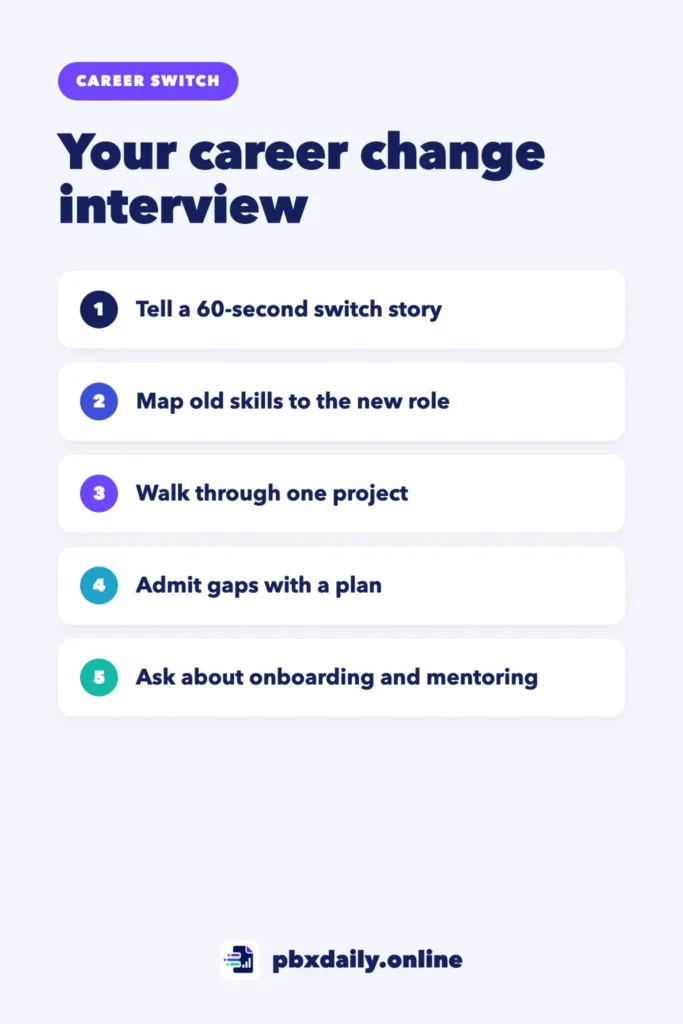
Before you practice individual questions, write one short story you can tell in about a minute. It becomes the base for “Tell me about yourself,” “Why tech?” and “Why this role?” Use four parts:
- Before: what you did and one thing you were good at.
- The turn: the moment you noticed you liked the technical side of the work.
- What you did about it: what you learned and built, with one specific example.
- Why this job: how the role connects your past and what you’ve learned.
Here’s an example from someone moving from retail management into IT support:



"I spent five years managing a retail store, where I was the person
everyone called when the registers or the scheduling system broke.
I started fixing those problems myself, then took the CompTIA A+
courses to understand what I was doing. Last year I set up a small
home lab and wrote step-by-step guides for my team on the issues we
saw most often. This help desk role is the job I was already doing on
the side, and I'd like to do it full time and keep growing in it."
Notice what’s missing: apologies, the full history of your career and anything negative about your old employer. Write your own version, read it out loud and cut it until it fits in about a minute.
Career Change Interview Questions and Sample Answers
These are the career change interview questions you’re most likely to hear. For each one, you’ll see what the interviewer is checking and a short sample answer to adapt. Don’t memorize the wording. Learn the shape of each answer and use your own details.
“Tell me about yourself.”
What they’re checking: whether you can tell a clear, relevant story. How to answer: use your 60-second story. End with the role you’re interviewing for, not with your old job.
“Why are you leaving your current field?”
What they’re checking: whether you’re running toward something or only away from something. Sample answer: “I liked helping customers, but the part I enjoyed most was figuring out why a system wasn’t working. I want a job where that’s the main task, not a side task.”
“Why this role?”
What they’re checking: whether you understand the job and chose it on purpose. Mention two or three things from the job description and connect each to something you’ve done. If you’re still deciding which role fits you, our guide to entry-level tech jobs for career changers compares the most common options.
“What skills from your previous job transfer to this one?”
What they’re checking: whether you can translate your experience. Pick two skills and give a concrete example for each. “Communication” alone means little. “I explained billing errors to upset customers every day and kept them as clients” shows it. Our guide on moving from customer service to tech has a table that maps common skills to tech roles, and the same translation works for your career change resume.
“How have you been learning?”
What they’re checking: whether you can learn on your own, which matters in every tech job. Name what you studied, how often and one thing you built or fixed with it. Specific beats impressive: “I study about an hour a day before work, and I finished a small JavaScript app that tracks my expenses” is better than a list of course names.
“Walk me through a project you built.”
What they’re checking: whether you understand your own work. Cover the problem, what you built, one decision you made and why, one thing that went wrong and how you fixed it, and what you’d improve. If your projects aren’t ready to show, start with our beginner developer portfolio guide. To show the project live, follow our guide on how to present your portfolio in an interview.
“You don’t have tech experience. Why should we hire you?”
What they’re checking: how you handle a direct challenge. Don’t argue and don’t apologize. Agree with the fact, then reframe it: “That’s true, I don’t have years in a tech job. What I do have is [skill from your old job], which [why it matters here], and I’ve already shown I can learn the technical side by [project or certification]. I’d expect to need help at first, and I know how to ask good questions.”
“Where do you see yourself in two years?”
What they’re checking: whether you’ll stay and grow. Describe getting good at this job first, then a reasonable next step on the same path. Avoid answers that suggest this role is only a stepping stone to something unrelated.
Technical Questions at Entry Level
The technical part depends on the role and the company, so ask the recruiter what to expect. These are common patterns:
- IT support or help desk: troubleshooting scenarios, such as “A user can’t connect to the Wi-Fi. What do you check first?” Talk through your steps in order, starting with the simplest causes.
- QA or software testing: “How would you test this login page?” List normal cases, wrong inputs and edge cases, then explain how you’d write a clear bug report.
- Junior web development: questions about HTML, CSS and JavaScript basics, a small coding exercise or a review of one of your projects.
You’ll hit a question you can’t answer. Saying “I don’t know” is fine if you follow it with how you’d find out: “I haven’t used that yet. I’d start with the official documentation, try it in a small test and ask a teammate if I got stuck.” That shows the habit they’re hiring for.
Think out loud during technical questions. Interviewers often care more about how you approach a problem than whether you reach a perfect answer.
Questions to Ask Them
At the end, you’ll usually get a chance to ask questions. Use it. As a career changer, these help you judge whether the team can support your growth:
- “What does onboarding look like for someone in this role?”
- “Who would I go to with questions in my first few months?”
- “What would a successful first 90 days look like?”
- “What do people who do well in this role have in common?”
Mistakes Career Changers Make in Interviews
- Apologizing for your background. Your old career is part of your value. Present it that way.
- Telling your whole history. Keep only the parts that support the job you want.
- Criticizing your old job or boss. Even if it’s true, it makes interviewers wonder what you’ll say about them.
- Claiming skills you can’t show. If it’s on your résumé, expect a question about it.
- Not knowing your own projects. Reread your code and notes before every interview.
Career Change Interviews: Frequently Asked Questions
How do I explain a career change in an interview?
Keep it short and forward-looking: what you did before, what made you interested in tech, what you’ve done to learn and why this role fits. Focus on what you’re moving toward. One minute is usually enough, and the interviewer will ask follow-up questions if they want more.
Should I say I’m still learning?
Yes, but frame it as a habit, not a gap. “I’m currently learning SQL and use it to analyze data from my side project” sounds like someone who keeps improving. Everyone in tech keeps learning, so this is normal.
How do I prepare for a technical interview with no tech experience?
Ask the recruiter what format to expect, review the basics listed in the job description and practice explaining one of your projects out loud. Then practice a few common questions for the role with a friend or by recording yourself. If the interview is with a company abroad, our guide on preparing for a remote interview with a foreign company covers time zones, setup and the usual stages.
Your Next Step
Write your 60-second career change story today and record yourself telling it. Then answer the eight questions above out loud, one per day. If you’ll interview in English, our list of English phrases for software developers includes phrases for technical interviews.

Luiz Loiola is a digital strategist and the founder of PBX Daily. He writes about technology, programming, artificial intelligence, freelancing, remote work, career change, and online income, helping beginners and professionals build practical digital skills, create new career opportunities, and compete in the global online market.