
You sign up for an online coding course, open the community chat and see message after message from people who just finished college. You’re 41, with a mortgage, two kids and fifteen years in logistics. The question comes back every evening: am I fooling myself?
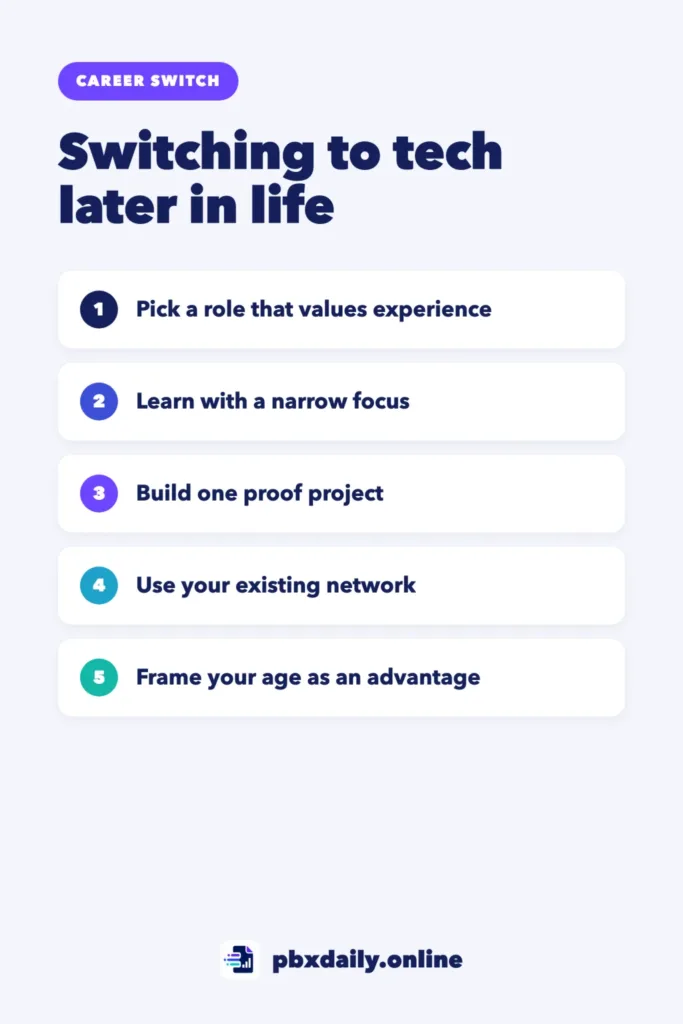
It’s not too late to switch to tech at 30, 40 or 50, but the path that works changes with age. Competing as if you were a 22-year-old graduate is the hard way. Choosing a role where your experience counts, learning with a narrow focus and using the network you already have is the easier one. This guide covers what really changes with age, how to deal with age bias, which roles fit later career changers and a six-month plan that fits around a full-time job.
Is It Too Late to Switch to Tech?
No. Tech isn’t a single job with a single entry point. It includes support, testing, data, implementation, product and many roles that sit between technical teams and customers. Plenty of them value people who have worked with real clients, real deadlines and real problems.
What is true: the later you switch, the less sense it makes to start from zero. You’ll get further by building on what you already know than by trying to erase it.
What Actually Changes With Age
Age changes your situation more than your ability to learn. Here’s what tends to shift at each stage.
In Your 30s
You probably have several years of work experience and some savings or at least a clearer budget. You may have less free time than at 22, but you also know how to work steadily. Most entry-level paths are open to you, including junior developer roles, if you’re willing to study consistently for a year or more.



In Your 40s
Your experience is now your strongest asset, and your time is your tightest limit. Family and financial commitments make a long unpaid break hard. Roles that connect your old field to tech, such as implementation, support for software in your industry or data work, often lead to a job faster than starting over as a generalist developer.
In Your 50s and Beyond
Your network and your judgment carry the most weight. Many people at this stage move into tech roles inside their current industry, or into freelance work where clients care about results more than age. Learning still works the same way: a little every day, with projects you can show.
Age Bias in Tech: What’s Real and What You Can Control
Age bias exists in some companies and some hiring processes. Pretending it doesn’t won’t help you, and assuming every rejection is about age won’t either. Focus on what you can control:
- Look current. Use the tools the job description names, and mention what you’re learning now.
- Show you can learn fast. A recent project or certification answers the “can they keep up?” doubt before anyone asks.
- Target the right employers. Companies that sell to your old industry, or that hire for customer-facing technical roles, tend to value experience more.
- Trim your résumé. You don’t need every job from the last 25 years. Keep the experience that supports the role you want.
Tech Roles Where Your Experience Counts
These roles let you use what you already know while you build technical skills:
- IT support and help desk: problem solving, patience and clear communication matter as much as technical knowledge.
- QA and software testing: attention to detail and knowing how real users behave.
- Implementation and onboarding specialist: helping companies set up software, often in an industry you already understand.
- Data or business analyst: turning questions from your old field into numbers and reports.
- Technical account management or customer success: combining client relationships with product knowledge.
Our guide to entry-level tech jobs for career changers compares these roles in more detail. If you’ve worked with customers, see also how to move from customer service to tech.
A 6-Month Plan for Career Changers With a Full-Time Job
This plan assumes about an hour a day on weekdays and a longer session on weekends.
- Month 1: choose one target role. Read job listings, pick the role that best connects to your experience and write down the five skills that appear most often.
- Months 2 and 3: learn the minimum for that role. One course or certification path, not five. Take notes on what you could use in your current job.
- Month 4: build one proof project. Ideally something that solves a problem from your current or past work.
- Month 5: update your résumé and profiles. Rewrite your experience in the language of the target role.
- Month 6: apply and talk to people. Tell former colleagues and contacts what you’re looking for. Referrals often matter more than cold applications.
For a broader version of this path, read our guide on how to switch to tech with no experience.
Money and Time: Switching Without Risking Your Income
The biggest practical difference for later career changers is that you usually can’t afford months without income. Plan the switch so your finances don’t force a bad decision:
- Keep your job while you learn. Studying in the evenings is slower, but it removes the pressure to accept the first offer that comes along.
- Know your number. Write down the lowest monthly income your household can live on. Entry-level tech salaries vary a lot by country and role, so compare that number with real listings near you before you resign.
- Build a buffer. If you can, save a few months of expenses before you change jobs. It gives you room if the first role doesn’t work out.
- Look for a bridge. A technical task in your current company, a small freelance project or a part-time role can give you experience before you leave.
- Avoid expensive shortcuts. A costly bootcamp isn’t required. Many people switch using free or low-cost courses plus one solid project.
Treat it as a project with milestones, not a leap. That’s often where older career changers have an edge: they’re used to planning.
How to Present Your Age as an Advantage
Your years of work are proof of skills that junior candidates can’t show yet: handling pressure, managing people, working with clients and finishing projects.
- On your résumé: lead with a short summary that connects your past to the new role, then list the most relevant experience first. Our career change resume guide has examples by background.
- In interviews: tell a short story of why you’re switching and what you’ve already built. Our list of career change interview questions for tech includes sample answers.
- With your network: people who have seen you work are your best source of introductions. Use them.
Mistakes Older Career Changers Make
- Hiding their experience. Removing it all makes you look like a beginner with gaps instead of a professional adding new skills.
- Collecting courses without projects. Certificates help, but a project you can explain helps more.
- Quitting too early. Learning while employed takes longer, but it keeps the pressure off your finances.
- Aiming only at large tech companies. Smaller companies and non-tech companies with tech teams are often more open to experienced career changers.
- Apologizing for their age. Present your background with confidence. It’s part of what you bring.
Switching to Tech Later in Life: Frequently Asked Questions
Is 40 too old to learn coding?
No. People learn to code at every age. What changes at 40 is usually time and responsibilities, not the ability to learn. A steady routine, such as an hour a day, and projects connected to your experience make the biggest difference.
Is it too late to become a software developer at 30?
No. At 30 you still have decades of career ahead, and many developers start in their late 20s or 30s. Expect to study consistently for a year or more and to build several projects before your first job.
What tech job is best for older career changers?
The best one is the role that uses the most of what you already know. For many people that’s IT support, QA, implementation, data analysis or customer-facing technical roles in their current industry. Start there, then move toward more technical work if you want to.
Do tech companies hire people over 50?
Yes, especially for roles where judgment and client experience matter, such as implementation, support leadership, technical sales and project roles. Your chances improve when you show recent skills, a current project and a clear link between your background and the job. It’s not too late to switch to tech at that age, but your network will often open more doors than job boards.
Your Next Step
Write down three things you did well in your current job and find one tech role whose listings ask for them. That role is your starting point. Then block one hour a day in your calendar for the next month and protect it.

Luiz Loiola is a digital strategist and the founder of PBX Daily. He writes about technology, programming, artificial intelligence, freelancing, remote work, career change, and online income, helping beginners and professionals build practical digital skills, create new career opportunities, and compete in the global online market.