
You’re the person at work who always notices the typo in the email, the broken link on the company site or the step in a process that doesn’t make sense. You’ve heard that software testing is a way into tech, but every QA job listing seems to ask for experience you don’t have.
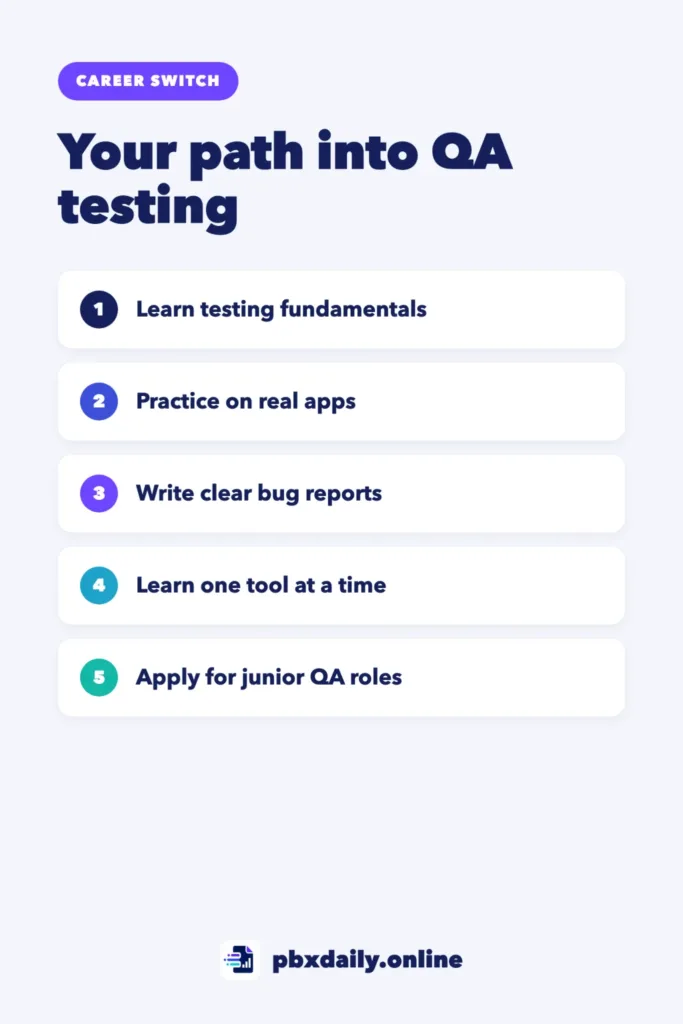
Getting into QA testing with no experience is realistic if you follow a clear order: learn how testing works, practice on real apps, produce proof of your work and apply to the right roles. This guide explains what a QA tester actually does, the skills and tools to learn first, whether certification is worth it, how manual and automation testing compare and how to land your first job.
What a QA Tester Actually Does
QA stands for quality assurance. A QA tester checks that software works the way it should before real users find the problems. On a typical day, a tester might:
- Read a new feature’s requirements and ask questions about unclear parts.
- Write test cases: step-by-step checks with an expected result.
- Run those tests on a website or app, on different browsers and devices.
- Find bugs and write clear reports so developers can reproduce and fix them.
- Check that fixed bugs stay fixed when new versions are released.
Testers work closely with developers, designers and product managers. Clear communication matters as much as technical skill.
Is QA a Good First Tech Job?
For many career changers, yes. QA values skills people bring from other jobs: attention to detail, following procedures, thinking like a customer and explaining problems clearly. You don’t need to be a strong programmer to start in manual testing, and the role gives you a close view of how software is built, which helps if you later want to move into automation, development or product work.
It’s not effortless. Junior QA roles get many applicants, so proof of your skills matters. Our comparison of entry-level tech jobs for career changers shows how QA compares with other starting roles.



How to Get Into QA Testing With No Experience: 5 Steps
Step 1: Learn Testing Fundamentals
Start with the core ideas every tester uses:
- Test cases: preconditions, steps, expected result and actual result.
- Types of testing: functional, regression, smoke, exploratory, usability.
- Test design techniques: boundary values (testing the edges, like 0, 1 and the maximum allowed) and equivalence partitioning (grouping inputs that should behave the same).
- Bug reports: title, steps to reproduce, expected and actual results, environment, severity and screenshots.
- The software development life cycle: where testing fits in Agile teams.
Step 2: Learn the Tools
Learn one tool at a time, with free versions where possible:
- A bug tracker: Jira or a similar tool. Many have free plans you can practice with.
- Browser developer tools: to check the console for errors, inspect elements and simulate mobile screens.
- An API client: Postman or a similar tool, to send requests and check responses.
- Basic SQL: enough to check whether data was saved correctly. Our guide to SQL queries for beginners covers the basics.
Step 3: Practice on Real Apps
Pick a public website or app you use, such as an online store’s search and checkout up to the payment step. Test it the way a tester would: write a few test cases, run them and note anything that doesn’t behave as expected. Test only as a normal user would. Don’t try to break into systems, overload them or bypass security, and follow the site’s terms of use.
Your old job can give you good test scenarios. Someone from retail knows how real customers use checkout flows. Someone from customer service knows which problems users report most. Our guide on moving from customer service to tech covers that transition in more detail.
Step 4: Decide on Certification
The most widely known entry-level certification is the ISTQB Certified Tester Foundation Level (CTFL). According to ISTQB, the exam has 40 questions, you need 26 points to pass and you get 60 minutes, plus 25% extra time if you take it in a language that isn’t your native one. ISTQB publishes the syllabus and sample exams on its website.
Certification isn’t required for every QA job, and it doesn’t replace practical proof. It helps most when job listings in your area mention it, or when you need a structured way to learn the vocabulary. If money is tight, study the free syllabus first and decide later whether to pay for the exam.
Step 5: Build Proof and Apply
Collect your practice work into a small portfolio: a short test plan, a set of test cases and three or four well-written bug reports. Our list of portfolio project ideas for beginners includes QA projects you can start with. For templates and a simple GitHub structure, see our guide to building a QA portfolio with no experience.
Then apply to roles with titles like Junior QA Tester, QA Analyst, Manual Tester or Software Tester. Rewrite your experience in testing language using our career change resume guide, and prepare for questions like “How would you test this login page?” with our list of career change interview questions for tech.
A Simple 8-Week Plan to Start
If you can study about an hour a day, this plan gives your learning a shape. Adjust it to your schedule.
- Weeks 1 and 2: testing fundamentals. Read the ISTQB Foundation syllabus or a beginner course, and write down every new term with a short example.
- Weeks 3 and 4: test cases and bug reports. Pick one public app and write 20 test cases for one feature. Run them and report what fails.
- Week 5: tools. Put your test cases and bugs into a free bug tracker, and use your browser’s developer tools to check console errors.
- Week 6: APIs and data. Send a few requests to a public practice API and write simple SQL queries on a sample database.
- Week 7: portfolio. Clean up your best work and put it in one place with a short summary.
- Week 8: applications. Update your résumé and LinkedIn, then apply to a few junior QA roles every week while you keep practicing.
The plan is a starting point. Many people need longer, especially while working full time, and that’s fine as long as you keep producing proof. Getting into QA testing with no experience is less about speed than about steady, visible progress.
Manual vs Automation Testing: Where to Start
| Manual testing | Automation testing | |
|---|---|---|
| What you do | Run tests yourself and report what you find | Write code that runs tests automatically |
| Coding needed | Little or none to start | Yes, usually JavaScript, Python or Java |
| Typical tools | Bug trackers, browser tools, test case managers | Playwright, Selenium, Cypress and API test tools |
| Best for beginners who | Want the fastest path to a first QA role | Already code a little or want a longer-term path |
Most people start with manual testing and learn automation on the job or in parallel. Even if you aim for automation, you need the manual fundamentals first, because automated tests are only as good as the test cases behind them.
Mistakes to Avoid When Starting in QA
- Only collecting courses. Without test cases and bug reports to show, courses alone rarely get interviews.
- Writing vague bug reports. “Checkout doesn’t work” isn’t useful. Clear steps and expected results are the core skill.
- Jumping into automation too early. Learn what to test before learning how to automate it.
- Testing in ways that cause harm. Practice on public apps as a regular user, never by attacking or overloading them.
- Ignoring communication. Testers explain problems to busy people. Practice writing short, clear messages.
Getting Into QA: Frequently Asked Questions
Can I become a QA tester without a degree?
Many people do. Employers vary, but for junior manual testing roles, practical proof such as test cases, bug reports and a basic understanding of testing concepts often matters more than a degree. Check listings in your area to see what local employers ask for.
How long does it take to get into QA with no experience?
It depends on your available time and your local job market. A common pattern is a few months of steady study and practice, followed by an active job search. Studying a little every day and building proof as you go is more effective than long, irregular sessions.
Is QA being replaced by AI?
AI tools are changing how testing is done, for example by helping write test cases or scripts. Someone still needs to decide what to test, judge whether a result is actually correct and communicate risks to the team. Learning how to use AI tools as part of testing is a smart addition, not a replacement for the fundamentals.
Sources
Your Next Step
Pick one public website you use often and write five test cases for its search feature today. Run them, and write a proper bug report for anything that doesn’t work as expected. That’s your first piece of QA proof.

Luiz Loiola is a digital strategist and the founder of PBX Daily. He writes about technology, programming, artificial intelligence, freelancing, remote work, career change, and online income, helping beginners and professionals build practical digital skills, create new career opportunities, and compete in the global online market.