
You finish your first project for a client in another country and send an invoice by email. A week later, their accounts team replies: they can’t process it. Your address is missing, the currency isn’t clear and there’s no invoice number. The payment waits while you fix it.
Learning how to invoice international clients is mostly about clarity. The person who pays you may never have heard of you, may not read your language well and has to match your invoice to their records. This guide covers what to include, which currency to use, payment instructions, a simple template, the tax forms US clients may ask for and how to handle late payments.
How to Invoice International Clients: What’s Different
An invoice is a request for payment that lists what you did, how much it costs and how to pay. A local invoice and an international one have the same basics, plus a few extra challenges:
- Currency: you need to state exactly which currency the amount is in.
- Payment method: local bank details may not work across borders, so instructions need to be complete.
- Language and format: dates, decimal marks and addresses are written differently in different countries.
- Taxes and paperwork: the rules depend on your country and theirs, and the client may ask for a form before paying.
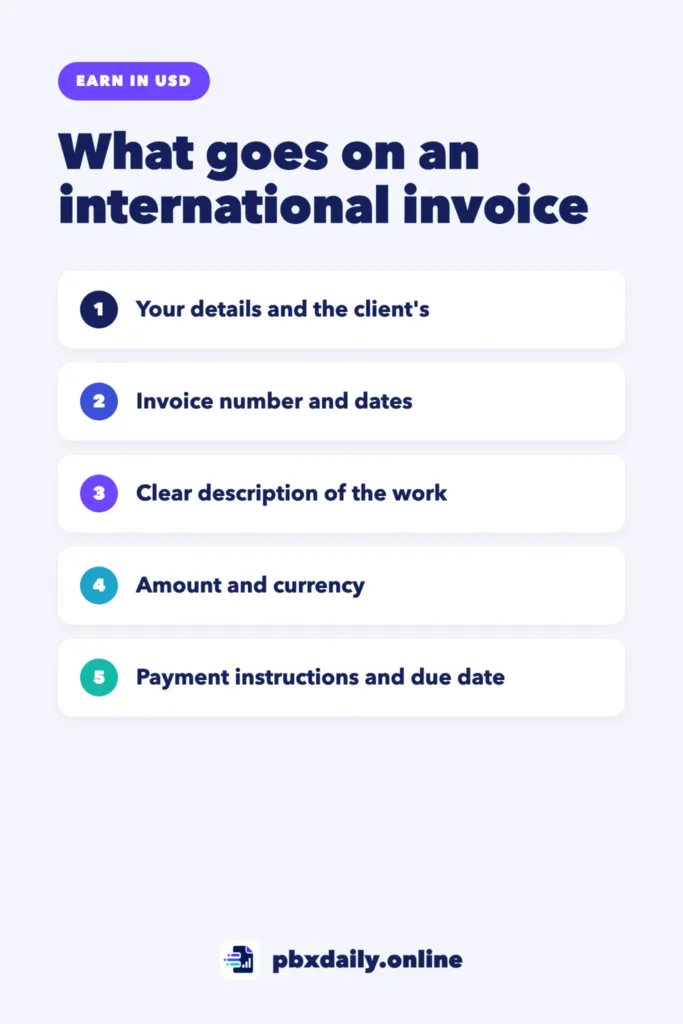
What to Include on an International Invoice
Include all of these, every time:
- The word “Invoice” at the top, so there’s no doubt what the document is.
- A unique invoice number, such as 2026-001. Use a simple sequence and never repeat a number.
- Issue date and due date. Write the month as a word, such as “October 13, 2026,” to avoid confusion between date formats.
- Your details: full name or business name, address including country, email and any tax or business number your country requires.
- The client’s details: company name, address including country and the name of your contact. Ask whether their accounts team needs a purchase order number or a specific reference.
- A clear description of the work: each item on its own line, with quantity or hours, rate and amount. “Website development” is vague. “Five-page website, design and development, as agreed in the proposal of [date]” is clear.
- The total and currency, using the currency code, such as USD, EUR or GBP.
- Payment instructions: exactly how and where to pay.
- Payment terms: when payment is due and any late payment terms you agreed.
If your country requires specific information on invoices, such as a tax registration number, add it. A local accountant can tell you what’s mandatory where you live.
Which Currency Should You Invoice In?
You have two main choices:



- The client’s currency, often USD, EUR or GBP. It’s easier for the client to approve and pay, and it’s what many international clients expect. You take on the conversion cost and the exchange rate risk.
- Your local currency. You know exactly what you’ll receive, but the client has to convert, which can slow down approval or make your price look odd.
Many freelancers invoice in the client’s currency and choose a payment service that converts at a fair rate. Agree on the currency before you start the work and write it in your proposal or contract. If you are negotiating a full-time remote role, see our guide on how to negotiate a remote job offer. Our comparison of Wise vs Payoneer vs PayPal shows how to check the real cost of receiving money in each one.
Payment Instructions That Don’t Get Lost
Unclear payment details are one of the most common reasons international payments are delayed. Make them hard to get wrong:
- Give the exact account details your payment service shows for receiving that currency. Copy them, don’t type them from memory.
- Write the account holder’s name exactly as it appears on the account.
- Ask the client to include the invoice number as the payment reference.
- If you accept more than one method, list them in order of preference.
- Say who pays the transfer fees, if you agreed on that.
Never change your payment details in a casual email. If they change, send a new invoice and confirm it through another channel, such as a call. Scammers sometimes pretend to be freelancers or clients to redirect payments.
A Simple International Invoice Template
Copy this into a document or spreadsheet and replace everything in brackets.
INVOICE

Invoice number: [2026-001]
Issue date: [October 13, 2026]
Due date: [October 27, 2026]

FROM
[Your full name or business name]
[Street address, city, postal code, country]
[Email]
[Tax or business number, if required in your country]

BILL TO
[Client company name]
Attn: [contact name]
[Street address, city, postal code, country]
[Purchase order or reference, if they gave you one]

DESCRIPTION                                   QTY   RATE      AMOUNT
[Five-page website, design and development]   1     [price]   [amount]
[Extra revision round, approved on (date)]    1     [price]   [amount]

TOTAL DUE: [amount] [USD]

PAYMENT INSTRUCTIONS
Method: [bank transfer / payment service]
Account holder: [name exactly as on the account]
[Account details for receiving this currency]
Reference: please include the invoice number [2026-001]

TERMS
Payment due within [14] days of the issue date.
[Late payment terms, if agreed]

Thank you for your business.
Save every invoice as a PDF with the invoice number in the file name, and keep a copy for your records.
Tax Forms Clients May Ask For
Tax rules for freelancers who work across borders depend on where you live, where the client is and sometimes on treaties between the two countries. This guide can’t tell you what you owe. It can tell you about one form that often surprises freelancers working with US clients.
US clients often ask foreign freelancers to fill in Form W-8BEN before they pay. It’s an official IRS form that individuals use to certify that they are a foreign person for US tax withholding and reporting. A few points from the IRS instructions for Form W-8BEN:
- You give it to the person or company that asks for it, usually the client or platform paying you. You don’t send it to the IRS.
- Generally, it stays valid from the date you sign it until the last day of the third calendar year after that, unless your information changes.
- Businesses use a different form, W-8BEN-E.
Download the form only from the IRS page for Form W-8BEN. If a section isn’t clear to you, especially the part about tax treaties, ask an accountant in your country before you sign it.
Clients in other countries may ask for different documents. And in your own country, you may need to declare international income and keep records of each payment. Our guide on getting paid by foreign clients lists the records worth saving.
Payment Terms and Late Payments
Agree on payment terms before the work starts and write them in your contract. Common choices are payment within 7, 14 or 30 days of the invoice date, often with a deposit before you begin. Our guide on what to include in a freelance contract covers deposits and late payment terms.
If the due date passes, send a polite reminder. Most late payments are forgotten, not refused.
Hi [name],

A quick reminder that invoice [number] for [amount] [currency] was due
on [date]. I've attached it again for convenience. Could you let me
know when the payment is scheduled?

Thanks,
[Your name]
If there’s no reply after a week, follow up again and ask whether the invoice reached the right person in their accounts team. For help writing clear messages to clients abroad, see our guide on how to communicate with international clients in English.
Tools for Creating Invoices
For your first clients, a well-organized document or spreadsheet saved as a PDF is enough. As you get more clients, invoicing software or the invoice feature in your payment service can save time with numbering, reminders and records. Whatever you use, check that it lets you choose the currency and add your full payment instructions. For the rest of your setup, see our starter stack of tools for freelance developers.
Invoicing International Clients: Frequently Asked Questions
Do I need a company to invoice international clients?
Not always. In many countries, individuals can invoice as freelancers or sole traders, but the rules vary. Some countries require you to register before you can issue invoices or to use a specific invoice format. Check with a local accountant before your first international invoice.
How do I invoice a US client from another country?
Send an invoice with all the fields listed above, in the currency you agreed, usually USD. Include payment instructions that work for receiving USD from abroad. Be ready for the client to ask for Form W-8BEN before they pay.
What payment terms should I use?
Choose terms you can live with and agree on them before the work starts. Many freelancers ask for a deposit up front and the rest within 14 days of delivery. Larger companies may have their own standard terms, so ask about them early.
Note: This article is general information, not tax or legal advice. Rules for invoicing, taxes and international payments vary by country. Talk to a qualified accountant where you live before making decisions.
Sources
Your Next Step
Copy the template above into a document today and fill in everything that doesn’t change between clients: your details, payment instructions and terms. Save it as your invoice template. Once you know how to invoice international clients, each new invoice takes five minutes instead of an evening.

Luiz Loiola is a digital strategist and the founder of PBX Daily. He writes about technology, programming, artificial intelligence, freelancing, remote work, career change, and online income, helping beginners and professionals build practical digital skills, create new career opportunities, and compete in the global online market.