
You finished a website for a local bakery. The owner loved it, thanked you twice and said she’d “definitely recommend you.” Three months later, you have no testimonial on your site, no new client from her and no idea whether she ever mentioned you to anyone.
Client testimonials and referrals rarely happen on their own. They come from asking at the right moment, making it easy to say yes and staying in touch after the project ends. This guide covers when to ask, ready-to-use email templates, what makes a testimonial useful, where to show it, how to ask for referrals and the honesty rules you need to follow.
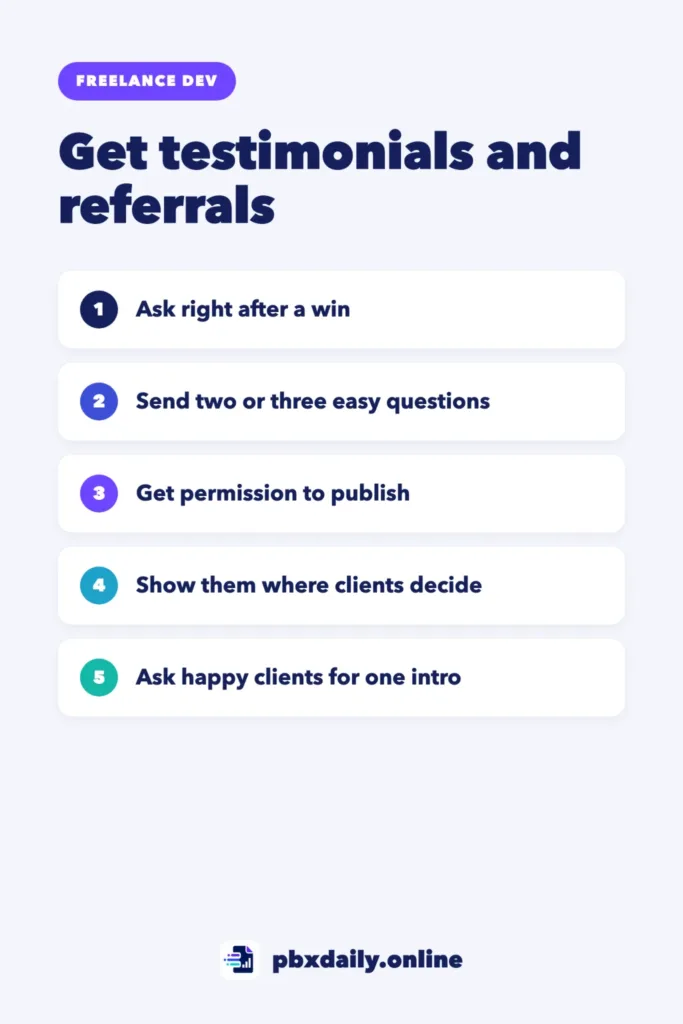
Why Testimonials and Referrals Matter Most at the Start
When you’re new, potential clients can’t see years of reviews or a long client list. A few specific words from real clients reduce the risk they feel in hiring you. Referrals do even more: a client who arrives through a recommendation already trusts you a little, and often needs less convincing on price.
Both come from the same source: a client who had a good experience and remembers you.
When to Ask
The best moment is right after a visible win, when the client is happiest:
- The day the site goes live and they share it with friends.
- When they send a message saying something is working well.
- When they report a result, such as more inquiries or bookings.
- At the final handover, once everything is approved and paid.
Avoid asking in the middle of the project, when there are open issues, or months later, when the details have faded.



How to Ask for a Testimonial
Make it easy. Instead of asking for “a testimonial,” ask two or three specific questions the client can answer in a few minutes:
Subject: A quick favor about the website

Hi [name],

I'm really glad the new site is live. Would you be willing to
share a few words about working together? Two or three sentences
are perfect. These questions might help:

1. What was the problem before we started?
2. What was it like working with me?
3. What has changed since the site went live?

With your permission, I'd like to put your answer on my website,
along with your name and business name. If you'd prefer only your
first name, that's fine too.

Thanks,
[Your name]
If the client already praised you in an email or message, you can ask: “Would you mind if I used what you wrote as a testimonial on my site?” Always get permission before publishing.
What Makes a Testimonial Useful
Compare these two:
- “Great work, highly recommended!”
- “Before the new site, customers kept calling to ask our opening hours. Now they find everything online and book directly. Ana explained each step clearly and delivered a week early.”
The second one describes a problem, a result and what it was like to work with you. That’s what convinces a new client. Specific details, a real name, the business name and, if possible, a photo or link make a testimonial more believable.
Where to Use Testimonials
- Your website: near your services and contact page, where people decide whether to reach out. Our guide on how to build a freelance website shows where testimonials fit on each page.
- Next to each project: a short quote on the project page or case study.
- In proposals: one relevant testimonial from a similar client. Our guide on how to write a freelance proposal that gets replies shows where it fits.
- LinkedIn: ask happy clients to write a recommendation on your profile.
How to Ask for Referrals
Many satisfied clients are happy to recommend you but don’t think to do it. Ask clearly and make it specific:
Subject: Do you know anyone who might need help?

Hi [name],

Thanks again for trusting me with the website. I'm taking on a
few new projects next month. If you know another business owner
who needs a website or wants to improve theirs, I'd be grateful
for an introduction.

Here's a one-line description you can forward:
"[Your name] builds simple, fast websites for small businesses.
[Link to your portfolio]"

No pressure at all, and thanks either way.
[Your name]
Giving them a ready-made sentence makes passing your name along much easier. If you met the client on a freelance platform, follow that platform’s rules about contact and payments outside it. Our comparison of Upwork vs Fiverr vs direct clients explains them.
Stay in Touch After the Project
Referrals often come months later. Stay on your clients’ radar without being pushy:
- Send a short check-in a few months after launch to ask if everything is working.
- Share a useful tip related to their site, such as updating opening hours before a holiday.
- Offer a small maintenance package or a follow-up improvement.
Subject: How's the website doing?

Hi [name],

It's been about three months since the site went live, so I wanted
to check in. Is everything working well? If anything needs a small
update, just let me know.

[Your name]
A smooth project makes all of this easier. Clear scope and good handling of extra requests, as covered in how to handle scope creep as a freelancer, leave clients happy enough to recommend you.
Turn a Happy Client Into a Case Study
Your best client relationships can become more than a quote. With permission, turn one project into a short case study: the client’s problem, what you built, the result and their testimonial. A real story with a real business behind it is one of the strongest things you can show a new client in the same industry.
Keep it short and let the client review it before you publish. Some clients will share it themselves, which brings you even more visibility. Our guide to the developer portfolio case study has a template you can adapt for client work.
What Not to Do When Asking
- Don’t ask while there’s an open problem. Fix it first.
- Don’t send a long form. Two or three questions get answers; ten questions get ignored.
- Don’t ask repeatedly. One request and one follow-up is enough.
- Don’t make referrals awkward. Ask for an introduction, not for the client to sell you.
Rules to Follow
Testimonials only work if they’re real. In the United States, the Federal Trade Commission announced a final rule in August 2024 that bans fake reviews and testimonials, including ones attributed to people who don’t exist or didn’t actually use the service. Other countries have their own consumer protection rules. Wherever you work, follow these basics:
- Only publish testimonials from real clients, with their permission.
- Don’t change the meaning of what they wrote. Shortening is fine if you keep the message.
- Don’t offer discounts or gifts in exchange for positive reviews.
- Remove a testimonial if the client asks you to.
Client Testimonials: Frequently Asked Questions
What if a client never replies to my testimonial request?
Send one friendly follow-up after a week. If there’s still no reply, let it go. Busy clients often mean to answer and forget. A shorter request, such as “Could I quote the message you sent when the site launched?”, sometimes works better.
Can I write the testimonial for the client to approve?
Some clients prefer this, but it should reflect what they actually said or experienced. A safer approach is to draft it from their own words in emails or calls and ask them to edit and approve it before you publish anything.
How many testimonials do I need?
Two or three specific ones are enough to start. As you complete more projects, keep the ones that best match the type of client you want to attract.
Sources
- U.S. Federal Trade Commission: Federal Trade Commission Announces Final Rule Banning Fake Reviews and Testimonials (August 2024)
Your Next Step
Think of your last satisfied client and send them the testimonial email above today. Then add the referral template to your project handover checklist. If you’re still looking for that first client, start with our guide on how to get your first freelance web development client.

Luiz Loiola is a digital strategist and the founder of PBX Daily. He writes about technology, programming, artificial intelligence, freelancing, remote work, career change, and online income, helping beginners and professionals build practical digital skills, create new career opportunities, and compete in the global online market.