
Your first potential client asks a simple question: “How much?” You pick a number that feels safe, they agree immediately, and three rounds of revisions later you realize you’ve been working for almost nothing.
Learning how to price freelance web development work is mostly learning to estimate honestly and to agree on terms before you start. This guide gives you a simple method you can repeat on every project, without guessing and without copying a number you found online.
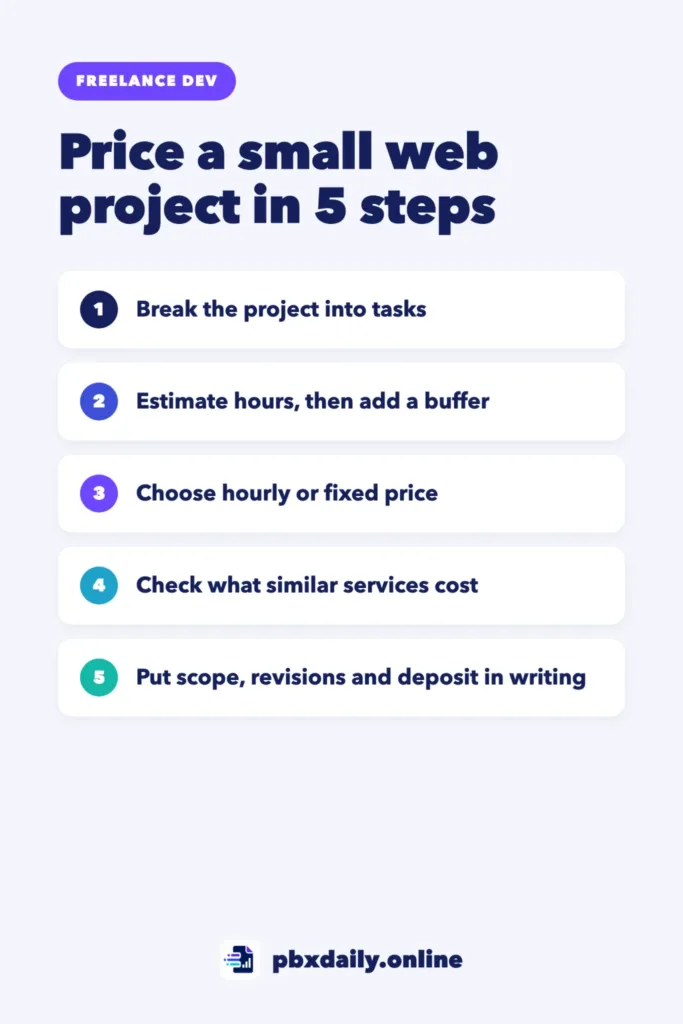
Why Beginners Underprice
- Fear of losing the client. A low number feels like the safest way to get a yes.
- Counting only coding time. Calls, emails, revisions, testing and publishing take time too.
- No written scope. Without one, the project keeps growing while the price stays the same.
- Comparing with the wrong market. Prices from another country or platform may have nothing to do with your client’s reality.
Step 1: Break the Project Into Tasks
List everything the project needs, not just the pages. For a simple one-page website, that might include a planning call, a layout sketch, building the page, making it responsive, a contact form, basic SEO settings, testing on different devices, publishing and a short handover to the client.
Step 2: Estimate Hours and Add a Buffer
Estimate each task in hours, then add a buffer for the unexpected. Beginners almost always underestimate, so the buffer isn’t padding; it’s realism. Track your actual time on this project. Next time, your estimates will be based on data instead of hope.
Step 3: Choose Hourly, Fixed or Package Pricing
| Model | How it works | Good for | Watch out for |
|---|---|---|---|
| Hourly | The client pays for the time you spend | Unclear or changing projects | Clients may worry about open-ended costs |
| Fixed price | One price for a clearly defined scope | Small, well-defined projects | Underestimating and scope creep |
| Package | A predefined offer, such as “one-page site with contact form” | Repeatable offers for one type of client | Packages need clear limits |
For a first project with a clear scope, a fixed price is often the easiest for the client to accept, as long as the scope is written down.
Step 4: Check What Similar Services Cost Where Your Client Is
Your price should make sense in your client’s market, not only in yours. To research it:



- Look at freelancers offering similar services in the same city or country as your client.
- Check the rates shown on freelance marketplace profiles for comparable work and experience.
- Ask freelancers in local communities what they charge for similar projects.
You’re looking for a realistic range, not a single “correct” number. As a beginner, starting in the lower part of that range is reasonable, as long as the price still covers your time.
Step 5: Put Scope, Revisions and Payment Terms in Writing
A price only means something next to a written scope. Before you start, agree on the deliverables, what isn’t included, the number of revision rounds, the timeline and the payment terms, including a deposit. Our guide on how to get your first freelance web development client explains how to scope that first project. If your client is abroad, compare Wise vs Payoneer vs PayPal before you agree on how you’ll be paid.
A Worked Example
The numbers below are hypothetical and only show the method. Replace them with your own estimates and a rate that fits your client’s market.
| Task | Estimated hours |
|---|---|
| Planning call and layout | 3 |
| Building the page | 6 |
| Responsive adjustments | 3 |
| Contact form and testing | 3 |
| Publishing and handover | 2 |
| Subtotal | 17 |
| Buffer (about 25%) | 4 |
| Total | 21 |
Multiply the total by your hourly rate to get a fixed price. Present it as the price for the defined scope, with two rounds of revisions included and any extra changes billed separately.
When and How to Raise Your Rates
Raise your prices when you’re consistently busy, when your estimates have become accurate, or when you can show results from previous projects. Apply new rates to new clients first, and give existing clients notice before changing theirs.
Your Next Step
Take a service you’d like to offer, list every task and estimate the hours today. Even before you have a client, you’ll know what a fair price looks like for you.

Luiz Loiola is a digital strategist and the founder of PBX Daily. He writes about technology, programming, artificial intelligence, freelancing, remote work, career change, and online income, helping beginners and professionals build practical digital skills, create new career opportunities, and compete in the global online market.