
Many career changers choose web development because it’s the role everyone talks about. A month later, they’re stuck on CSS layouts and wondering whether tech was a mistake. Often the problem isn’t tech. It’s the role.
Most lists of entry level tech jobs for career changers rank roles by hype or salary. This guide compares four common starting points by something more useful: what the work feels like day to day, who tends to enjoy it and how you can prove you can do it. At the end you’ll find a short self-assessment and a weekend test for each role, so you can choose based on experience rather than headlines.
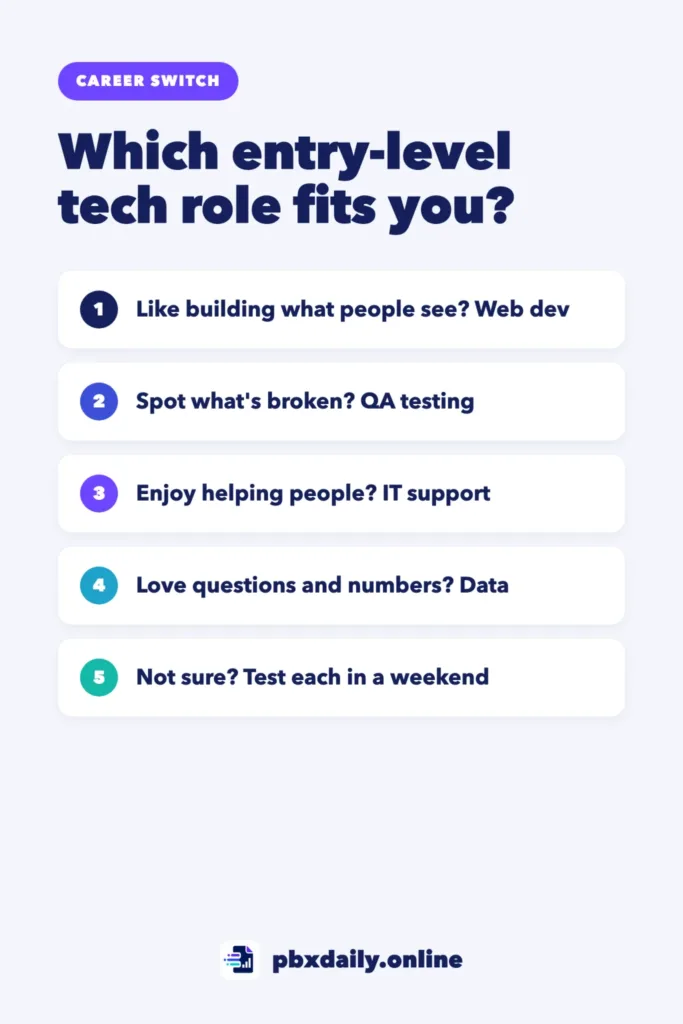
How to Compare Entry-Level Tech Roles
Before looking at specific jobs, decide what matters to you. Five questions make the comparison concrete:
- What does a normal day look like?
- What kind of problems will you solve?
- How much will you talk to people, and how much will you work alone?
- Which tools will you use?
- How can you prove your skills before anyone hires you?
Web Development
What the Day Looks Like
Front-end web developers build the parts of websites and apps that people see and use. A typical day mixes writing code, fixing layout and behavior bugs, reviewing changes with teammates and turning designs into working pages.
It Fits You If…
You like seeing visible results quickly, enjoy puzzles that take patience and don’t mind that the tools change often.
How to Prove It
Two or three small, live sites or apps with public code. If you’re starting from zero, follow the right order to learn HTML, CSS and JavaScript. In the United States, the BLS projects employment of web developers and digital designers to grow 5% from 2025 to 2035, and it notes that specific education credentials aren’t always required when you can show your abilities through projects.



QA / Software Testing
What the Day Looks Like
QA testers check that software works as intended before users find the problems. The work includes writing test cases, exploring features to find where they break, reporting bugs clearly and confirming fixes. Over time, many testers learn to automate their checks with code.
It Fits You If…
You notice details others miss, like following a process carefully and can describe a problem in clear, neutral language.
How to Prove It
A test plan and a set of well-written bug reports for a real, public app. In the United States, the BLS projects employment of software quality assurance analysts and testers to grow 6% from 2025 to 2035. The same page says the broader occupation group typically requires a bachelor’s degree, so if you don’t have one, a strong portfolio matters even more.
IT Support
What the Day Looks Like
IT support specialists help people solve problems with computers, software, accounts and networks. Expect tickets, step-by-step troubleshooting, documentation and a lot of conversation with non-technical users.
It Fits You If…
You stay calm when people are frustrated, enjoy fixing things one step at a time and like knowing your help made someone’s day easier. Coming from a support job? Read from customer service to tech.
How to Prove It
A documented home lab or troubleshooting guide, plus entry-level IT certifications. The BLS notes that candidates for computer support roles may qualify with a high school diploma plus relevant IT certifications. It also projects employment of computer support specialists to decline 3% from 2025 to 2035 in the United States, so check listings in your own market before you commit.
Data Analysis
What the Day Looks Like
Entry-level data analysts collect, clean and summarize data so others can make decisions. Most of the work happens in spreadsheets, SQL and dashboards, followed by explaining what the numbers mean.
It Fits You If…
You like asking “why?”, enjoy organizing messy information and are comfortable presenting findings to people who aren’t data experts.
How to Prove It
A short analysis of a public dataset that answers one clear question, with your spreadsheet or SQL queries attached.
Side-by-Side Comparison
| Role | Typical day | Contact with people | Core tools | Best proof |
|---|---|---|---|---|
| Web development | Building and fixing pages and features | Medium: team, sometimes clients | HTML, CSS, JavaScript, Git | Live sites with public code |
| QA / testing | Testing features and reporting bugs | Medium: developers and product team | Test cases, bug trackers, basic SQL | Test plan and bug reports |
| IT support | Solving users’ technical problems | High: end users all day | Operating systems, networking basics, ticket systems | Troubleshooting guide and certifications |
| Data analysis | Cleaning and summarizing data | Medium: people who need the answers | Spreadsheets, SQL, charts | Analysis of a public dataset |
A Quick Self-Assessment
Answer each question with a simple yes or no:
- Do you enjoy making things look and work right on a screen? (Web development)
- Do you naturally notice mistakes and inconsistencies? (QA)
- Do people come to you when their phone, computer or app stops working? (IT support)
- Do you like turning messy information into a clear answer? (Data analysis)
- Would you rather work mostly in writing, or talk to people throughout the day?
If two or more answers point to the same role, that’s a good place to start. If your answers are split, that’s normal. The weekend test below will help you decide.
Test Before You Commit
Spend one weekend on a tiny version of each role you’re considering:
- Web development: build and publish a one-page site about a hobby.
- QA: write ten test cases for the sign-up flow of an app you use and report any bug you find.
- IT support: set up a virtual machine and document every step and every problem.
- Data analysis: answer three questions about a public dataset in a spreadsheet.
Once you’ve chosen, our roadmap on how to switch to tech with no experience explains what to learn, build and apply for next.
Sources
- U.S. Bureau of Labor Statistics: Web Developers and Digital Designers, Occupational Outlook Handbook
- U.S. Bureau of Labor Statistics: Software Developers, Quality Assurance Analysts, and Testers, Occupational Outlook Handbook
- U.S. Bureau of Labor Statistics: Computer Support Specialists, Occupational Outlook Handbook
Your Next Step
Pick the two roles that scored highest in your self-assessment and schedule their weekend tests. By the end of next weekend, you’ll have real evidence, not guesses, about where to start.

Luiz Loiola is a digital strategist and the founder of PBX Daily. He writes about technology, programming, artificial intelligence, freelancing, remote work, career change, and online income, helping beginners and professionals build practical digital skills, create new career opportunities, and compete in the global online market.